
Including client testimonials on your website is a powerful way of leveraging social proof to build trust with site visitors, but there’s definitely a right and a wrong way to go about it.

There's no claim you can make that a customer can't make better than you can on your behalf. It's one thing to say, 'we care about customers.' It's another thing for someone else to validate and affirm it by sharing their experience and going on the record.
-Joel Klettke, Conversion Rate Expert
If you’re looking to generate more leads and business from your website, and you want to see how testimonials can help, you’ve come to the right place. We’ll examine the psychological reasons why testimonials are so powerful, how to optimize them for SEO and CRO (conversion rate optimization), the best ways to gather them, and provide some powerful examples along the way.
But first, many people conflate testimonials with reviews. That’s not surprising, as they’re often used interchangeably, but here’s how I split them up:
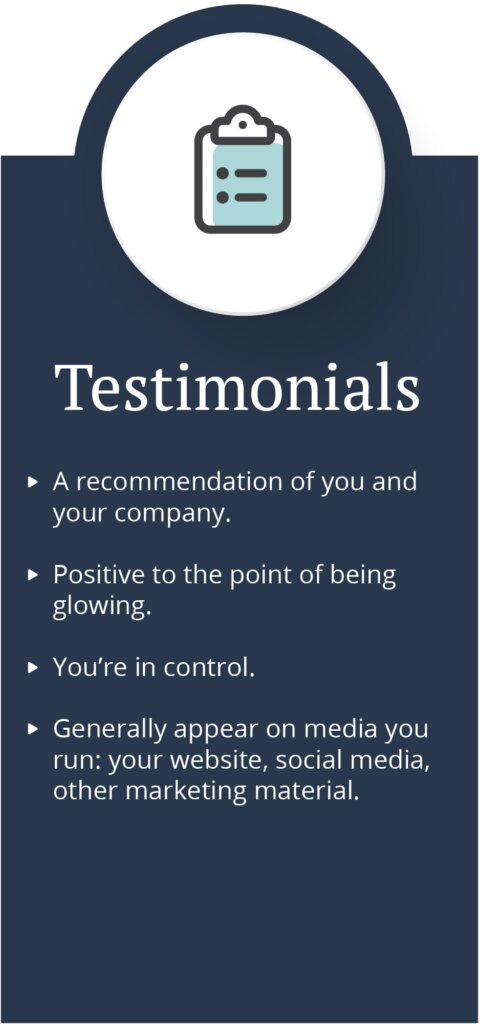
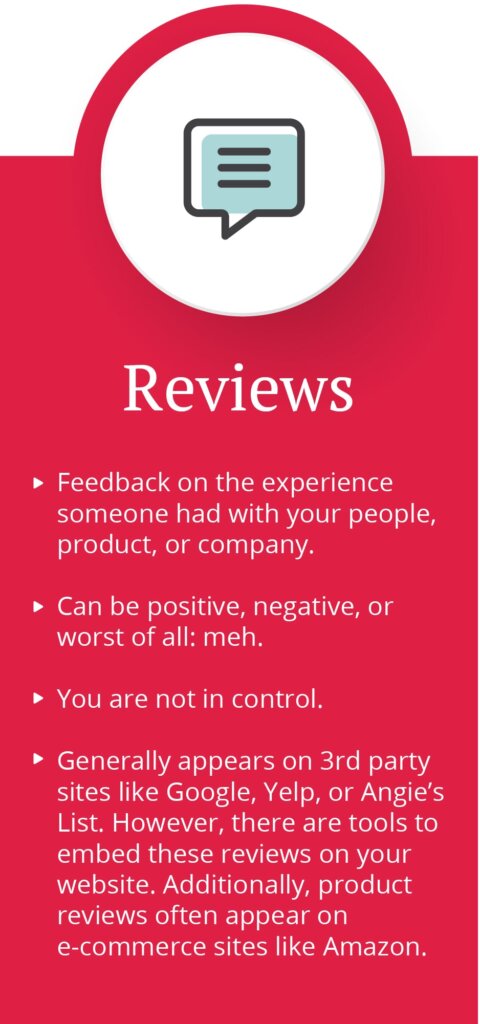
We’re going to be talking about testimonials: solicited, positive feedback that you can control and put on your own controlled media to help you grow your business. So let’s dive in!
The Psychological Power Behind Testimonials
If you’re wondering why testimonials are so powerful, it’s because they tap into a powerful psychological concept called “social proof” which was popularized by Dr. Robert Cialdini in his seminal book, Influence: The Psychology of Persuasion. (I bet you didn’t know you were going to read the word “seminal” today, but here we are. )
Social proof is a phenomenon where people assume the actions of others are correct, and follow their lead or example. It’s especially powerful when we’re in a situation where we don’t have a lot of experience or knowledge. The visitors to your website might find themselves in that situation: they’re looking to purchase their first RV, investigating day care providers, or considering a direct mail campaign for their business.
Most times, they arrive not knowing much about your business, and you only have a few seconds to convince them to stick around. Social proof–in the form of testimonials–is one powerful tool we have to persuade them. Or, as Dr. Cialdini called it: a weapon of influence.
But not all testimonials are created equal, and there are ways to make the testimonials you collect and display work harder for you.
Specificity Matters in Website Testimonials
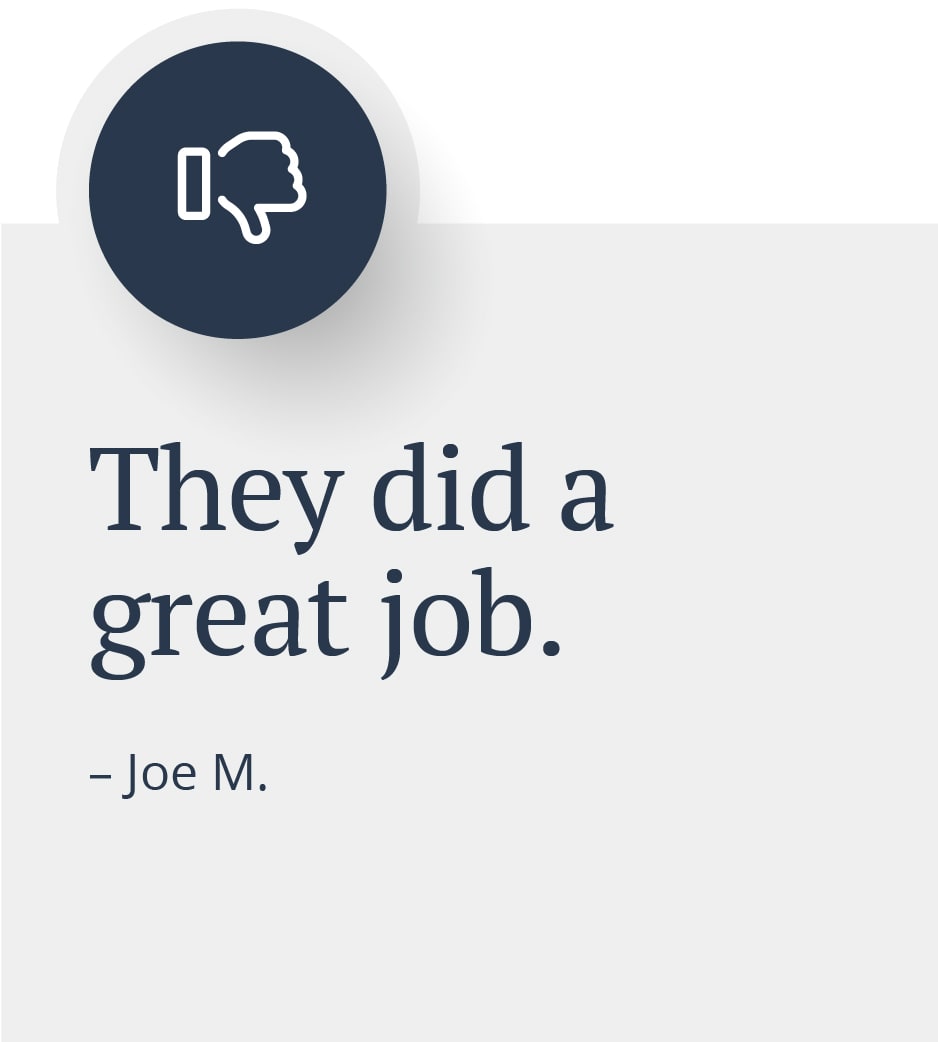

There are two things going on here: the specificity of the customer and the specificity of the message. Let’s start with the customer.
Although you would never invent a customer to get a testimonial, your site visitor doesn’t know or trust you yet. The more you can do to “anchor” this customer into the real world, the more likely the site visitor will believe in them.
Joe M., with no other identifying features, doesn’t seem as “real” as Mrs. Santarino. Using her full name, town, along with a photo of her in front of her house with the previously mentioned solar panels (with her permission, ‘natch,) gives her testimonial more weight than Joe’s.
Sorry, Joe.
The second important factor is the specificity of the testimonial. Remember: testimonials and social proof work best when we don’t have a lot of experience in a given area. Jane’s concern that she was hesitant to hire anyone because of cost and results likely mirror a lot of people who are considering a solar panel cleaning. But it worked for Jane, so maybe it will work for me, too!
Joe’s testimonial, however, is vague and doesn’t mention the services he received. Without that specificity we don’t know if Joe’s problems are the same as ours, and the testimonial falls flat.

When it comes to testimonials the biggest mistake brands make is using generic quotes and the "customary" logo bar as social proof. High-converting and persuasive social proof is one that dismantles prospects' hesitations or concerns and shows your audience that people just like them were able to solve their biggest problems using your solution.
Your goal should be to identify the biggest concerns or questions people have before choosing your solution and to use your testimonials to feature your best clients that faced similar situations / hardships / concerns that were immediately solved by your solution.
For example, if one of the top concerns people have with your solution is that it's super technical and will be hard for them to use, you should highlight a story by a customer that was worried about this exact same thing, and how excited they were to discover it wasn't, OR how much assistance and support they received from the team. Instead of just saying "it's easy to use" you now have a direct quote and proof to address this concern.
The SEO Power of Testimonials
The client testimonials on your website can do double duty by helping you rank higher at the search engines, too.
When you place customer testimonials on relevant pages–like your product or service pages–and those testimonials include specific keywords you’re targeting, it can improve the relevance of that page in the search results.
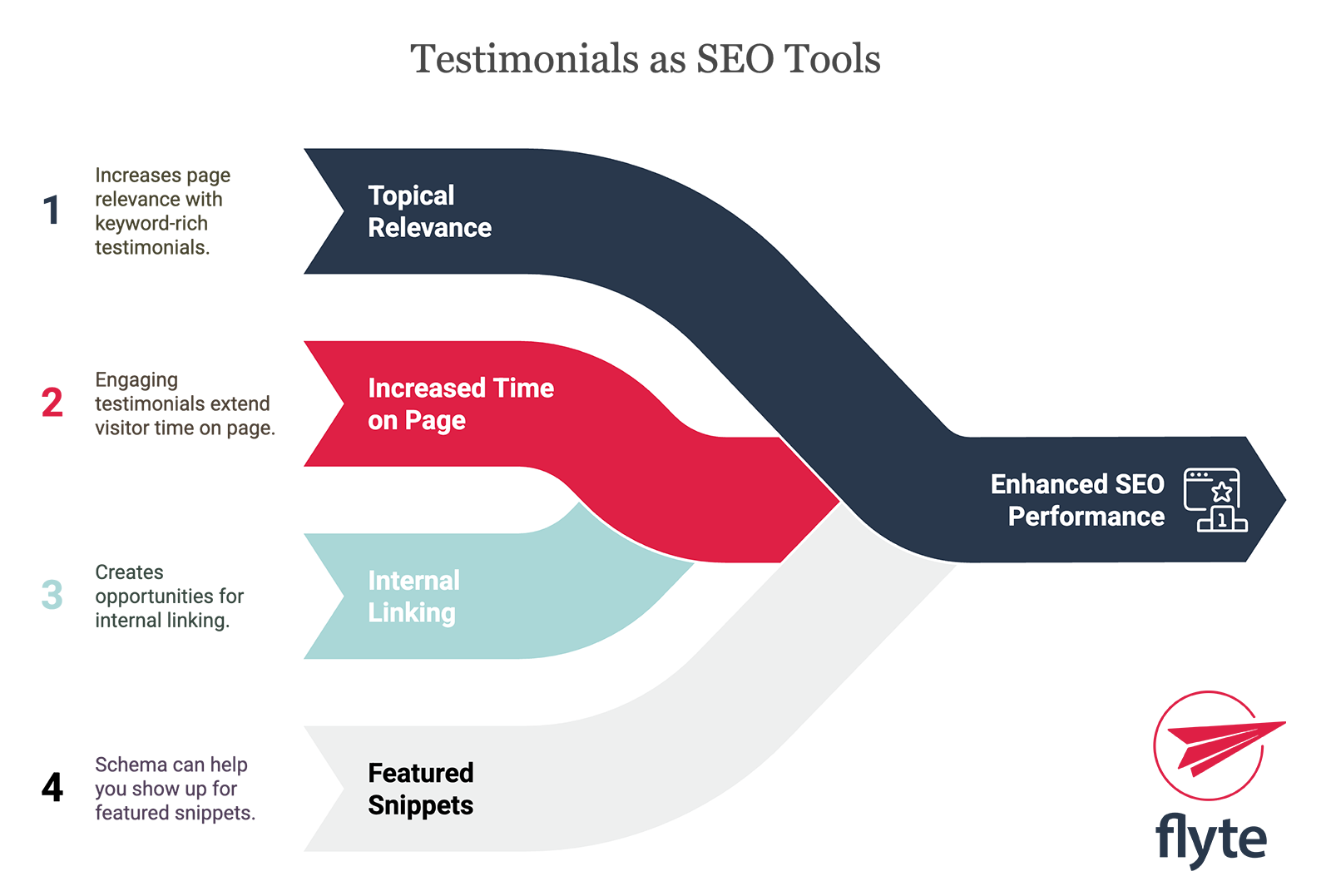
Here are a few ways testimonials can improve your search visibility and drive more qualified search traffic to your site:
- They reinforce topical relevance. If your client writes, “Your car detailing team did such a great job that you never would have guessed I spilled gasoline in the backseat,” that’s a keyword-rich endorsement Google can’t ignore.
- They increase time spent on page. Engaging testimonials keep site visitors on the page longer, signaling to search engines that you’ve got high quality, relevant content on your website.
- They create opportunities for internal linking. You can connect a testimonial quote to a related blog post or case study for even more SEO juice.
- They support featured snippets. If formatted properly—especially using semantic markup or schema—your testimonials can show up as rich results in search.
How to Make Testimonials “Pop!” on Your Website
Effective testimonials shouldn’t put the burden on your site visitor; they need to get the point across quickly, otherwise even the most glowing recommendation won’t have any effect.
Some recommendations:
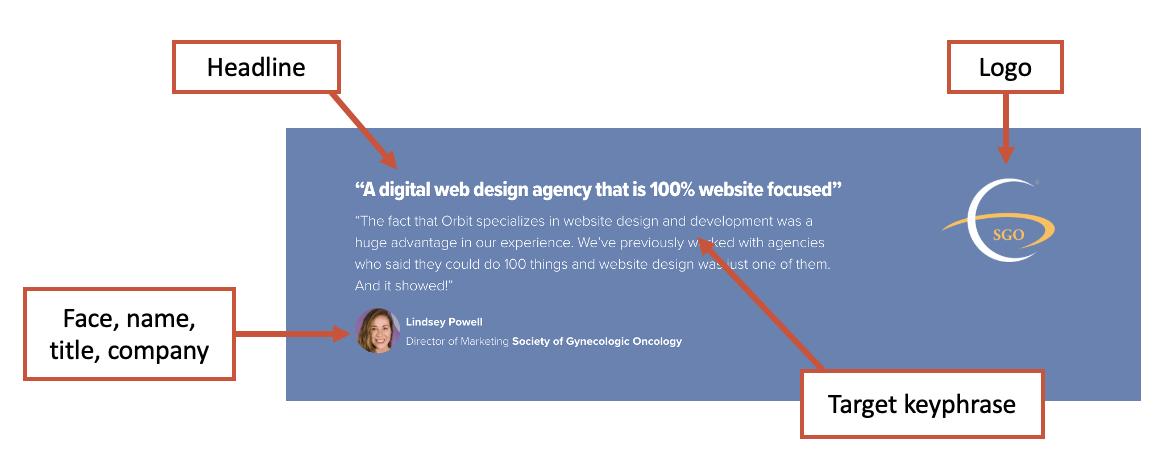
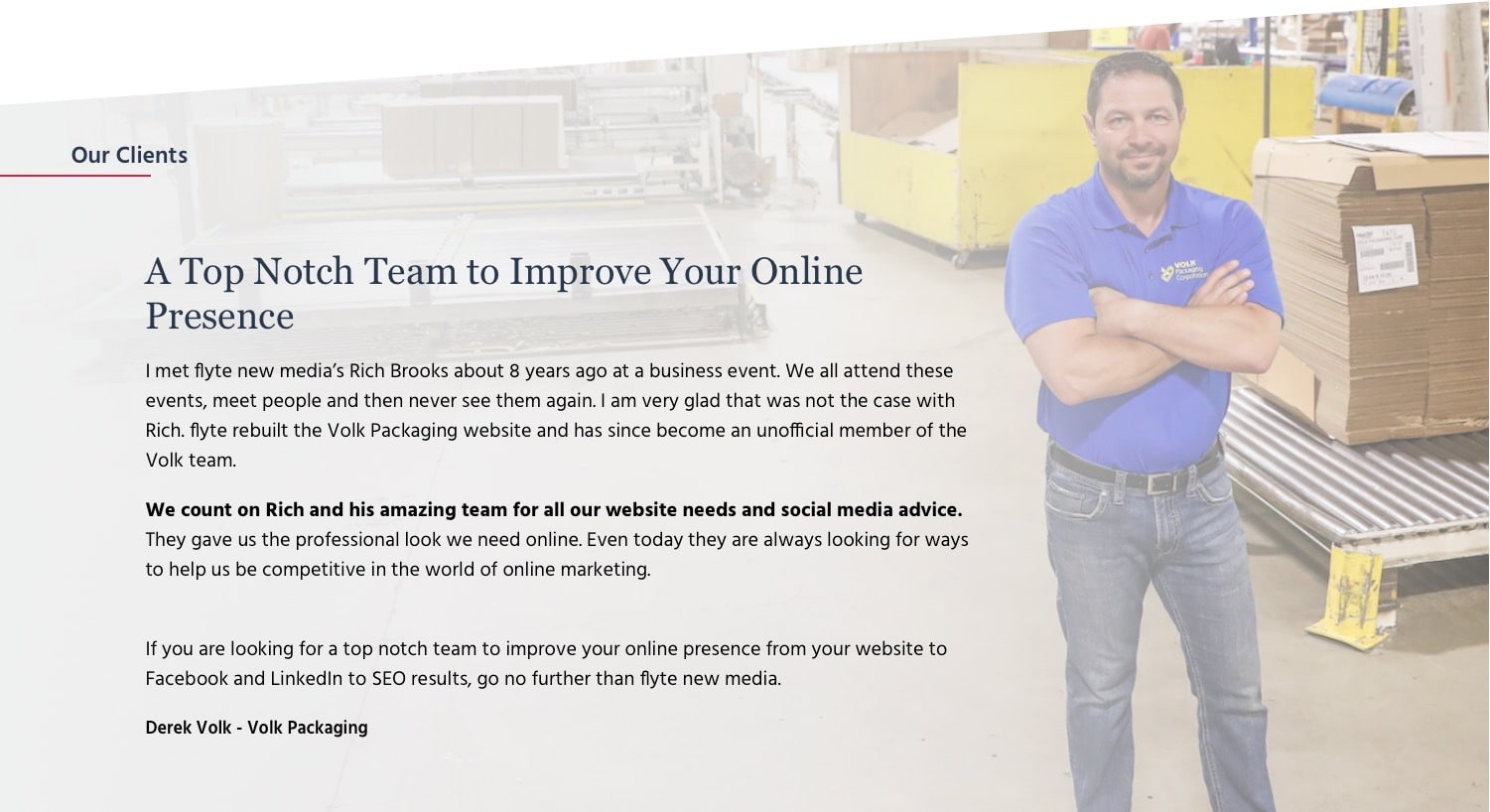
The testimonials should stand out on the page. Give them a consistent, special treatment throughout the website that might include a special font, icon, or formatting. Include relevant imagery or bright colors.
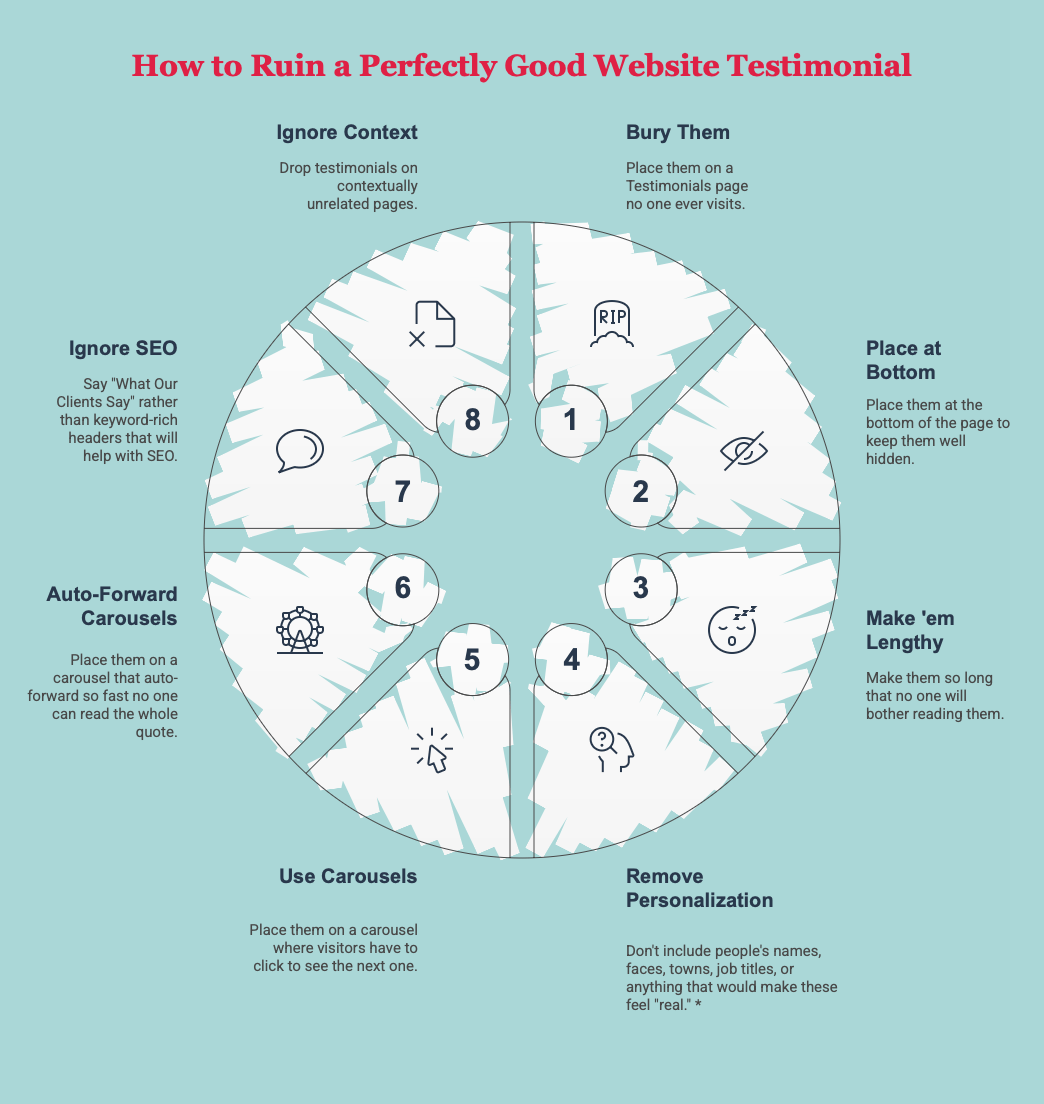
Grab the best bit and use it as the headline. Forget “What Our Clients Say” and replace that H2 or H3 tag with a quick, relevant, keyword-rich header, like: “My Chronic Back Pain Disappeared Overnight.”
Edit for brevity. People’s eyes glaze over when looking at big blocks of text. While there’s a place and time for long-form testimonials (they’re called case studies), most should be short and to the point. I often receive long, sometimes rambling testimonials. I’ll thank my client, then provide an edited version and ask them if it’s OK if I use this shorter version. No one’s ever said no.
Highlight the good stuff. Whether using bold, italics, or a literal highlighter effect, draw people’s attention to the most sensational parts of the testimonial.
Your testimonials can and should do double-duty as engaging page visuals or a way to break up sections of copy on a webpage.

Avoid making the most visually prominent part of the testimonial block (the H2 subhead) vague and meaningless ("What our clients say"). Instead, make the subhead the juiciest 6 words from the testimonial. Your visitor is more likely to read it as they scan down the page.
Where to Place Your Testimonials for Maximum Impact
Many businesses make the mistake of putting all of their testimonials on a single page–even including “Testimonials” as a primary navigation item.
However, it’s been my experience that testimonial pages are often the least visited pages on a website, rendering them virtually worthless.
Instead, distribute your testimonials throughout your website where they are most relevant. If a customer gave you a testimonial for your Ski & Bike shop that talks about your great selection of snowboarding boots, make sure that goes on your snowboarding page, not the page on e-bikes.
Here are some key pages where your testimonials will have the most impact:
- Your Homepage: This is likely the most visited page on your website, so a strong testimonial that reflects your business as a whole can do wonders here.
- Landing Pages: For any page that’s receiving targeted traffic from ads or other campaigns, a relevant testimonial can help seal the deal and get your prospect to keep moving forward.
- Product/Service Pages: As mentioned above, use testimonials that speak to the content on that page.
- E-Commerce Checkout Pages: Have you discovered a leak in your e-commerce funnel? Find a relevant testimonial that speaks to your high quality product, your quick delivery and turnaround, your support after the sale, or whatever will help reduce the fear of buyer’s remorse.
Common Mistakes with Testimonials
How to Get Great Testimonials
I’m going to skip over the obvious part about “doing great work.”
People can be terrified to ask anything of customers. Oh, we don't want to take their time. We don't want to put them on the spot. I'm nervous they'll say ‘no’…when really it should be an opportunity to make them look great and you look great.
It should be a celebration of a relationship and that you've done great work for a client. Most importantly--if you've been proactive about building a relationship-- talking about the result won’t be an alien concept.
-Joel Klettke, Conversion Rate Expert
There are a few ways to get enough high-quality testimonials for your website. If you have a high-volume business where you may not be able to follow up with every customer, (think coffee shop, e-commerce store, etc.), you may want to invest in some marketing automation that sends out customer surveys after the purchase.
As part of the survey you may ask for specific feedback around products the customer purchased, customer service, delivery times, value for the money, etc. You should also ask for permission to use the quotes in your marketing.
If you tend to have a low-volume business where you have longer-term relationships with your clients (like we do), having someone follow up after the work is done or after a set period of time has gone by is a good way to get feedback for future testimonials.
The bigger the scope of work, the deeper the relationship with your clients, the more you should use the personal touch.
Regardless of how many customers or clients you have, if someone goes out of there way to compliment your people, your products, your delivery time, etc., that’s a perfect time to ask if they’ll write you a testimonial that you can use in your marketing.
When I get a piece of unsolicited positive feedback, I’ll often follow up with an email asking if we can use what they said in a testimonial or would they be willing to write a testimonial for us.
For whatever reason, even if they agree to write a testimonial, the process can prove very difficult for some people, either because they’re too busy, they struggle with expressing themselves, or for some other reason. To make this easier on them (and to increase your chances of getting that testimonial,) you might:
- Remind them of what they specifically liked about your business: “You had mentioned how our event planner was able to get a replacement when the photographer called in sick on your wedding day.”
- Provide them with some keywords that describe your offering: “You were talking about how well our “energy-efficient, tax-deductable heat pumps” were to our technician.”
- (And, when all else fails) Write a draft for them: “Here’s what I heard you say, but I want to make sure I got it down correctly, so please let me know if I need to change anything.”
The last one is not my favorite, but I have had a client or two who really struggled to express themselves in writing. Just make sure you’re not putting words in their mouth, and you’re really just taking what they said to you in person (or over the phone, or during a Zoom call….)
Where Else to Use Testimonials
Your website isn’t the only place to use your hard-earned testimonials. After all, not everyone is visiting your website, and you want everyone to know how amazing you are! They can and should be repurposed for:
- Social Media: Make testimonials part of your regular editorial calendar.
- Email Marketing: If you’re sending out regular email newsletters or blasts, include testimonials here as well.
- Digital Ads: Put them in Facebook Ads, LinkedIn Ads, banner ads, and so on.
- Printed Marketing Material: There’s nothing wrong with printed collateral! Whether it’s a mailer, poster, or handout at a tradeshow, testimonials can work their magic just as well IRL!
- Proposals: Whether you deliver your proposals physically, in digital format, or via email, testimonials can help seal the deal at a critical decision making moment for your prospect.
Next Steps
Whether you’re gathering content for a new website, or trying to squeeze some additional sales out of your existing one, social proof–in the form of testimonials–is a powerful method to increase conversions and generate more business.
Keep these factors in mind as you’re gathering and placing your website testimonials:
- Don’t be afraid to ask for testimonials, and consider using an automated process for high-volume businesses.
- With permission, include names and other identifiers with testimonials.
- Place testimonials next to contextually-relevant content, reinforcing what you say about your offering with what your customers say.
- Make the testimonials pop visually and that they’re easy to scan.
- Make gathering and adding fresh testimonials to your website and other marketing collateral part of your workflow.
Need help gathering your client testimonials, or making the ones you have more effective on your website? Reach out to flyte today!

Rich Brooks is president of flyte new media, a digital agency in Portland, Maine, offering branding, web design, and digital marketing. He is a nationally recognized speaker on marketing, AI, and entrepreneurship.
He founded The Agents of Change, an annual conference and weekly podcast that focuses on digital marketing.
Rich is the author of The Lead Machine: The Small Business Guide to Digital Marketing, a popular and well-received book that helps entrepreneurs and marketers reach more of their ideal customers online.