
When I take over Meta Ads management for a client, I often find a single lonely campaign desperately trying to prove its worth—and often failing.
If you have one takeaway from this blog, it should be this: one campaign can’t do it all.
Why? Well, you’ll have to suffer through an analogy to find out.
Don’t Expect People to Jump Into the 8 ft Pool
The city of Portland, Maine recently completed a $12 million project to open a state of the art community pool just a few blocks from my house. And while I’m not much of a pool-goer myself, I have to admit that this one is pretty snazzy.

The Rising Eddy Community Pool features:
- 2 water slides
- Splash pad and other water features
- 9ft deep lap pool
- Zero-depth entry
Why should you, a social media advertiser, care about my community pool? Because it’s a lesson in planning carefully around your customer journey.
The city of Portland understood that its target audience was full of different types of people with different needs. Parents with young children, elderly and people with physical disabilities, and folks who needed a means of exercise, to name a few.
They used this information to create different points of entry into the pool: jump, slide, and wade. And they connected the different pool features to one another so that it was easy to go from just dipping in your toes to being comfortably submerged.
When your meta ads strategy is built around one campaign, you miss opportunities to reach people at all stages of your marketing funnel. And you stunt your ability to truly optimize for the folks you are successfully reaching.
It’s kind of like building a pool that’s 8 ft deep all the way around (with no ladders or stairs).
Sure, on an extra hot day (like when you’re running a sale) some people will go for it and just jump in. But plenty of others will stand at the edge, look down, and decide they’re not ready. Even the folks who do enjoy swimming in the deep end might turn away, because the environment you’ve created is unfamiliar and daunting.

By using a full funnel marketing strategy in Meta ads, you can reach new audiences, build trust, move warmer prospects closer to action, and re-engage people who have already interacted with your brand.
What is a Full Funnel Meta Ads Strategy?

A full-funnel Meta Ads strategy uses different campaign types, audiences, messages, and KPIs to support each stage of the digital customer journey.
Instead of asking one campaign to do everything, you build a connected system where each campaign has a specific job. Some campaigns introduce people to your brand. Some encourage users to engage or visit your website. Some drive leads or purchases. Others bring back past customers or warm prospects who didn’t convert the first time.
The point is not to run every possible campaign type just because Meta offers it. The point is to understand what each campaign objective is built to do, then choose the right combination based on your goals, audience, data, and budget.
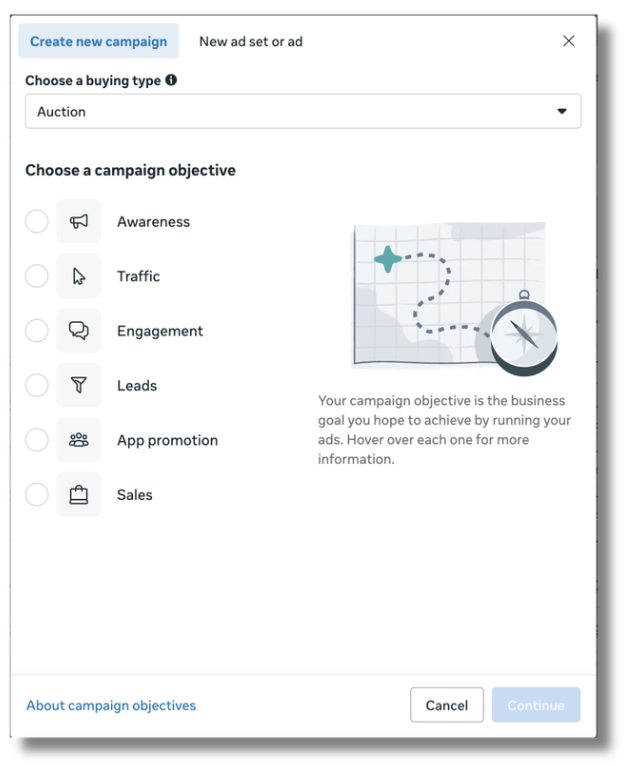
6 Meta Ads Campaign Objectives
When you create a new Meta campaign, one of the first choices you make is the campaign objective. It’s easy to breeze past this step because you’re excited to build your audience, write your copy, and get the ads live.
But this decision matters. A lot.
Your campaign objective tells Meta what kind of behavior to optimize for. In other words, it tells the platform what type of person to look for within your audience.
Meta currently offers six core campaign objectives:
|
Campaign Objective |
What Meta Optimizes For |
Common KPIs |
|---|---|---|
|
Awareness |
Showing ads to the maximum number of people within your targeting parameters |
Impressions, Reach, Ad Recall |
|
Engagement |
Reaching people likely to interact with your ads or content |
Video Views, Reactions, Comments, Event Responses |
|
Traffic |
Reaching people likely to click a link |
Link Clicks, Landing Page Views |
|
Leads |
Reaching people likely to submit information |
Form Fills, Calls, File Downloads, Signups |
|
App Promotion |
Reaching people likely to install or use an app |
App Downloads, App Events |
|
Sales |
Reaching people likely to take a conversion action |
Add to Cart, Begin Checkout, Purchase |
Here’s the key thing to remember: your campaign may generate more than one type of result, but Meta is only optimizing for one.
For example, a sales campaign may generate link clicks because people often have to visit your website to buy something. But that does not mean Meta is trying to maximize link clicks. A traffic campaign will almost always generate more clicks than a sales campaign with the same budget because that is the job you gave it.
This is where a lot of frustration starts.
Your boss might say, “We want to reach new audiences.” So, you run an awareness campaign. The campaign gets strong reach and impressions, exactly as intended. Then your boss asks, “Why didn’t we get more website traffic?”
Cue the internal screaming.
The problem is not necessarily that the campaign failed. The problem is that the business goal and campaign objective were not clearly aligned.
Before you choose an objective, ask this question: What is the one metric by which we’ll measure success?
That’s not to say you’ll only ever look at one Meta ads metric. But decide on the one that determines whether this campaign did the job it was built to do.
Match Meta Campaign Objectives to the Digital Customer Journey
Most marketing funnels include four core stages: awareness, consideration, conversion, and retention.
You don’t need to overcomplicate this. Think of these stages as levels of readiness.
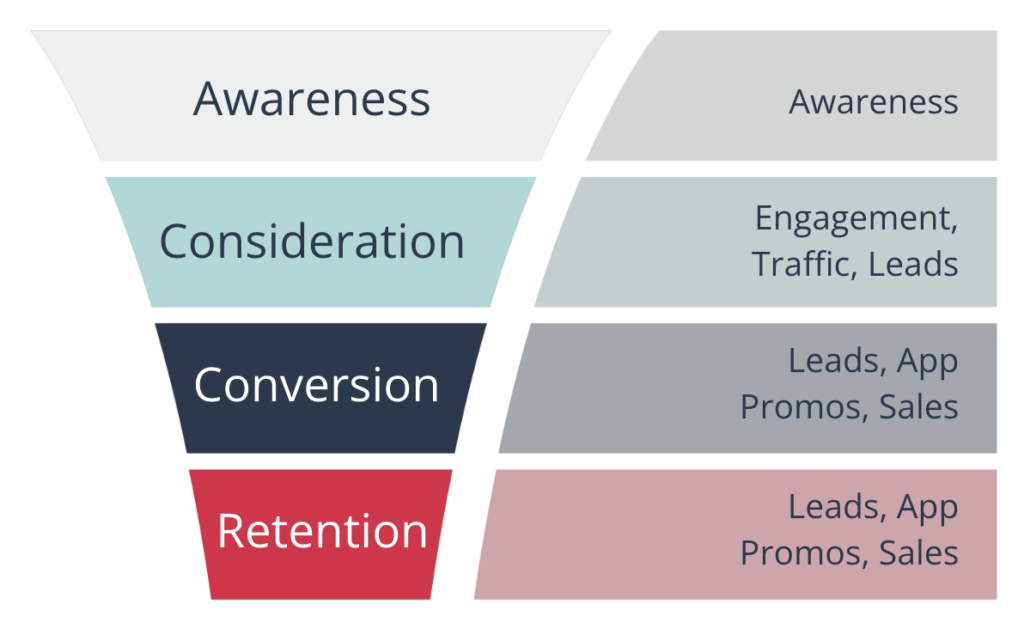
The awareness stage is the shallow entry point of the pool. Generally, it requires little or no action on the part of the user. We really just want them to know that your business, product, or service exists or just be aware that they have a problem or a pain point that is relevant to you. Big surprise, the campaign objective you use at this stage is Awareness, where the goal is just to get in front of as many eyeballs that meet our targeting parameters as possible.
In the consideration stage, users are starting to engage with you intentionally. They dip their toe in the water by watching a video, clicking to your website, or engaging with a post. Engagement and Traffic campaign objectives are used to identify people who are ready to participate in some way.
Depending on your business, the conversion stage may include submitting a lead form, booking a consultation, making a purchase, downloading an app, or signing up for an event. Use the Leads, App Promotion, or Sales objectives to drive these important actions.
Retention is the stage that often gets forgotten. These are people who have already completed at least one desired action, but that doesn’t mean their journey with your brand is over. Meta can help you stay in front of these users with repeat offers, upsells, reminders, or loyalty-focused messaging. You’ll likely also use Leads, App Promotion, or Sales here too.
Here’s why this matters: it often takes multiple touchpoints before someone becomes a customer. If your only campaign is focused on the final action, you’re assuming every person is ready for the deep end on day one.
Tracking Makes Your Ad Funnel Work
Once you’ve aligned your goal, objective, and funnel stage, you still need one more thing before you can build a true full-funnel Meta Ads strategy: analytics.
Without tracking, your funnel goes dark.
Imagine you successfully get someone to walk into your store, but the second they step inside, the lights turn off. You can’t see what aisle they walked down. You can’t tell whether they picked something up. You don’t know whether they were standing at the counter, ready to check out.
That’s what happens when you run ads without the right measurement setup.
At a minimum, you should have the Meta Pixel and Google Analytics 4 installed on your website.
The Meta Pixel sends website behavior back to Meta. This is especially important for traffic, leads, and sales campaigns because Meta needs to understand what users do after they click. If you run a sales campaign without a properly installed Pixel, Meta can’t clearly see when purchases happen, which means it can’t optimize toward people who are likely to purchase.
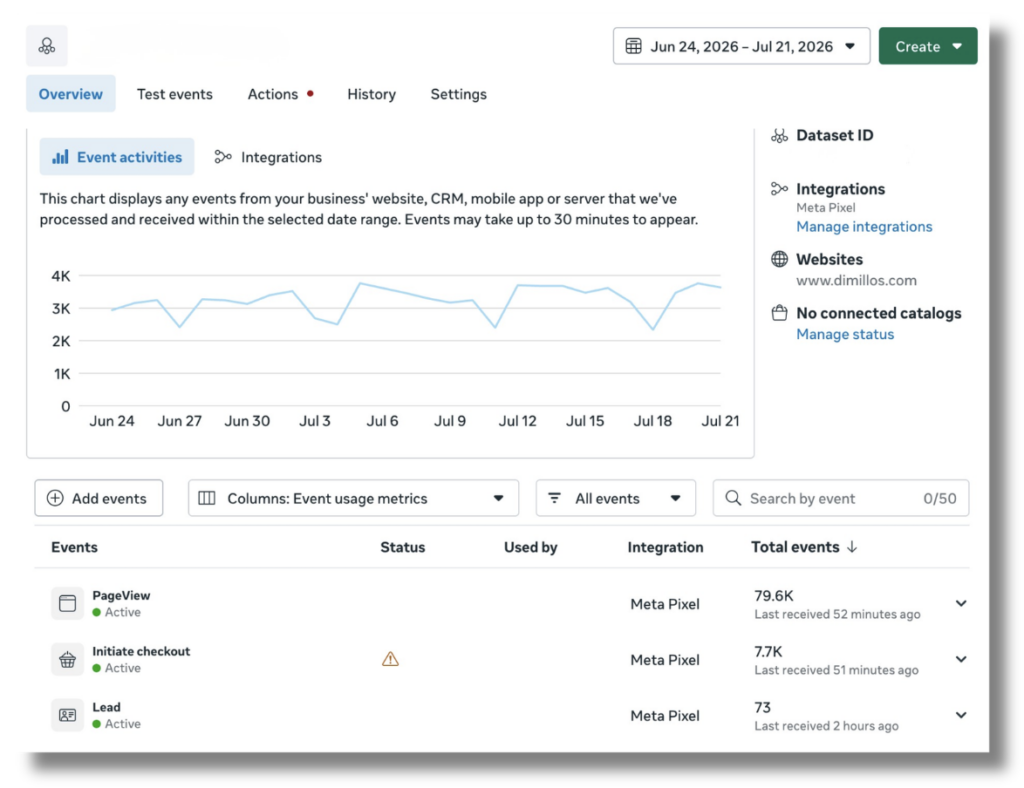
GA4 gives you a second layer of visibility. Meta may tell you it sent plenty of traffic, but GA4 helps you evaluate the quality of that traffic. Are users staying on the site? Are they viewing multiple pages? Are they engaging with key content? Are they converting?
Sometimes Meta thinks it did a great job because it generated clicks. Then you check GA4 and realize the average user stayed on the site for three seconds. That’s not consideration. That’s probably a thumb slip.
Google Tag Manager is also highly recommended. It makes it easier to manage your Meta Pixel, GA4, and other tracking tools in one place. It also allows you to create more specific events, like form starts, video views, button clicks, sample requests, or other actions that aren’t part of Meta’s standard events.
Use Meta Retargeting Ads to Connect Each Stage of the Funnel
Tracking is not just for reporting. It is what allows you to build retargeting audiences.
This is where the full funnel marketing strategy starts to feed itself.
A person who watched your video can be moved into a consideration campaign. A person who explored your service page for more than 30 seconds can be moved into a lead campaign. A person who added something to their cart but didn’t purchase can be shown a reminder. A past customer can be invited back for a seasonal offer.
Some useful Meta retargeting audiences include:
- Website visitors
- Specific page visitors
- People who clicked but did not convert
- Video viewers
- Facebook and Instagram engagers
- Lead form openers
- Current customer lists
- Past purchasers
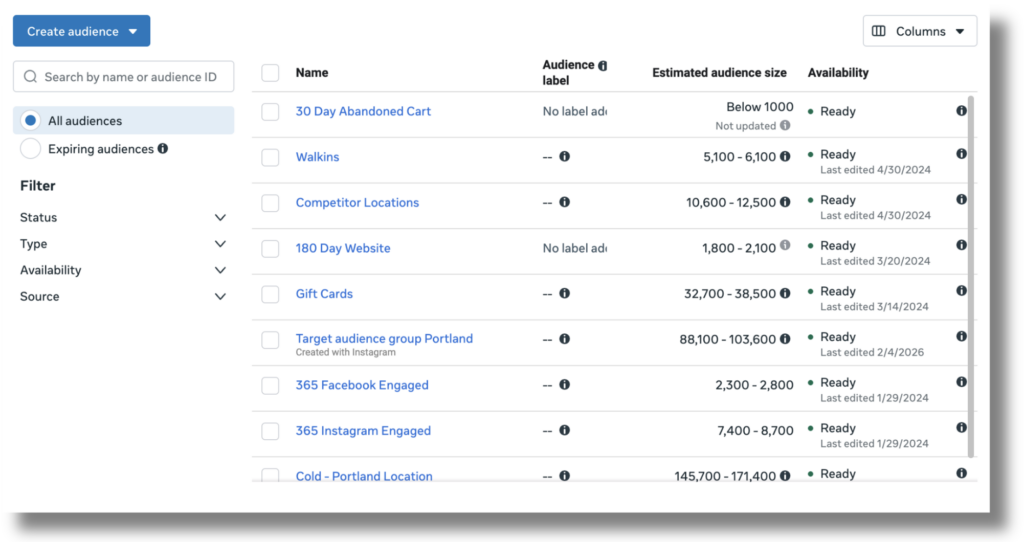
These audiences are the people who have already stepped onto the pool deck. Maybe they dipped a toe in. Maybe they watched someone else go down the slide. Maybe they got all the way to the deep end and climbed back out.
Meta retargeting ads make sure they aren’t treated like total strangers.
What About Advantage+ Audiences?
Advantage+ is everywhere in Meta Ads right now, sometimes for better and sometimes for worse.
Meta has access to a lot of user behavior data that advertisers cannot see directly. In many cases, its automated targeting tools can help identify strong prospects, especially when the campaign has enough data and the creative is doing its job.
But Advantage+ is not a replacement for strategy.
If you don’t understand your funnel, your audience, or your measurement setup, Advantage+ can keep you stuck in a “throw spaghetti against the wall” stage. It may find some good users. It may also spend inefficiently because it does not have strong signals to guide it.
For early-funnel campaigns, like awareness or engagement, broader targeting and Advantage+ can work well because the goal is often to learn who responds. But as you move deeper into the funnel, you want stronger data, clearer audiences, and more intentional messaging.
Automation is helpful, but it’s not a babysitter.
Build Creative Around Your Ad Funnel
Now the fun part begins: messaging and creative.
The same message should not be used at every stage of your digital customer journey.
- At the early stage, introduce the problem and your brand. This is where you might use educational content, brand storytelling, short videos, or high-level pain point messaging.
- In the middle stage, educate and compare. Answer common objections. Explain how your service works. Show what makes you different. Help users decide whether you belong on their shortlist.
- At the late stage, make the offer clear and easy to act on. This is where a quote request, booking link, limited-time offer, abandoned cart message, or direct sales CTA makes more sense.
- For retention, remind, reward, and deepen the relationship. These users already know you, so the message can be more direct, more specific, and more personalized.
A full funnel marketing strategy is about giving each campaign the right job, the right audience, and the right message.
Which Meta Ads Campaign Objectives to Use With a Small Budget
In a perfect world, every business would run campaigns at each stage of the funnel. Awareness, consideration, conversion, retention—the whole pool.

But limited budgets are real and spreading $10 a day across five campaigns is not a full-funnel strategy; it’s a great way to make sure none of your campaigns have enough budget to work.
Start with data.
A campaign is almost guaranteed to struggle if your daily budget is lower than the average cost per result. If your average cost per click is $1.50, a traffic campaign with a $1 daily budget is not realistic. Likewise, if your average lead costs $15, a lead campaign with a $10 daily budget is underfunded.
Ideally, you should use your own historical data to make this decision. If you don’t have that yet, industry benchmarks can give you a starting point. Just remember to replace those benchmarks with your own numbers as soon as your campaign starts collecting meaningful data.
If you can only afford one campaign, the best choice depends on your business goal, audience size, website, and existing data. But if I had to choose one practical starting point for many small businesses, I’d often choose a traffic campaign.
Traffic campaigns are not as inexpensive as awareness or engagement campaigns, but they are usually affordable enough to generate useful activity within a tight budget. More importantly, they send people to your website, which gives you data beyond what happens inside Facebook and Instagram.
You can learn which pages people visit, how long they stay, what content they care about, and whether they take meaningful actions. That data can support future Meta ads campaigns, retargeting audiences, SEO decisions, email marketing, and more.
The Takeaway: Create Meta Ads Campaigns that Work Together
- Different audiences need different entry points.
- Campaign objectives tell Meta what kind of behavior to optimize for.
- Tracking and retargeting turn separate campaigns into a connected funnel.
Build the shallow entry, bring people further in with splash features, and then send them into the deep end on the slide. And when your funnel is working as intended, the best part is that the next person will be lined up to step into the pool as soon as the last one reaches 8 ft depth.
Last tip: One campaign can’t do it all, nor can one marketing platform.
If your pool needs another entry point, flyte new media can help. We build thoughtful, measurable ad strategies that account for the full customer journey, so your campaigns work together instead of fighting to do everything at once.

Izzy joins flyte after moving to Portland in 2020, a city that is affably similar to her beloved Burlington, Vermont, with the added benefit of ocean air and fresh seafood. With a degree in English and a background in the nonprofit sector, she carries a curiosity for all things communications. From social media and email newsletters to website management and SEO, Izzy is involved. Reach out to Izzy today!