
Although I’ve been doing email marketing for flyte since the 20th century (for real), we haven’t always had an email drip campaign. Sure, we had a customized welcome email, delivered to a new subscriber after sign up, but that was it.
A single email.
And then I hoped that my brilliant insights and clever writing each month would entice people to do business with us. And back at the turn of the century–when emails were all text and we were churning our own butter–there was so little competition that we could get away with it.
But today, it’s a much more crowded and competitive marketplace. If you have a long sales cycle, an expensive offering, or need to build trust with people before they’ll even talk with you, you need to implement an effective drip campaign that warms leads and converts prospects.
Most of today’s articles on drip campaigns focus on e-commerce or SAAS companies and include suggestions like sending emails when someone abandons your cart or “best practices for onboarding sequences.” There’s no need to rehash what already exists.
In this article, we’ll focus on what service businesses can do, what goes into a welcome sequence, and how you can build trust with new subscribers.
What is an Email Drip Campaign and Why Do You Need One?
An email drip sequence is a triggered series of pre-written emails that are delivered on a schedule (every day, every three days, etc.) The drip campaign is triggered by an event such as downloading a white paper, watching a video, or submitting a quote request.
A welcome email sequence is the same, but triggered solely by someone signing up or being added to your newsletter. It’s often some of the first communication you have with a prospect, and it can be tailored to where they are in the customer journey.
That differs from a typical business email newsletter, which has a regular cadence: daily, weekly, or monthly. After someone signs up they get the next scheduled issue when everyone else does, regardless of where they are in their own customer journey.
Welcome emails are incredibly powerful because they tend to have the highest open rate of any email you’ll send. Ever.
This is because it strikes while the iron is hot: your prospect just signed up for your newsletter or registered for a webinar, and their interest is piqued. If there’s a lead magnet in play, such as a download, they are likely leaving your email registration page and heading straight for their inbox.

One of the most powerful automated campaigns in your arsenal if you're B2B is that lead nurture campaign. You could literally not do your newsletter and just do lead nurture…that's how important it is.
The purpose behind your welcome sequence depends on your business model. In e-commerce, the goal of a drip campaign is transactional. In SaaS, it’s onboarding. In lead generation, it’s about building trust.
What Triggers a Welcome Drip Campaign?
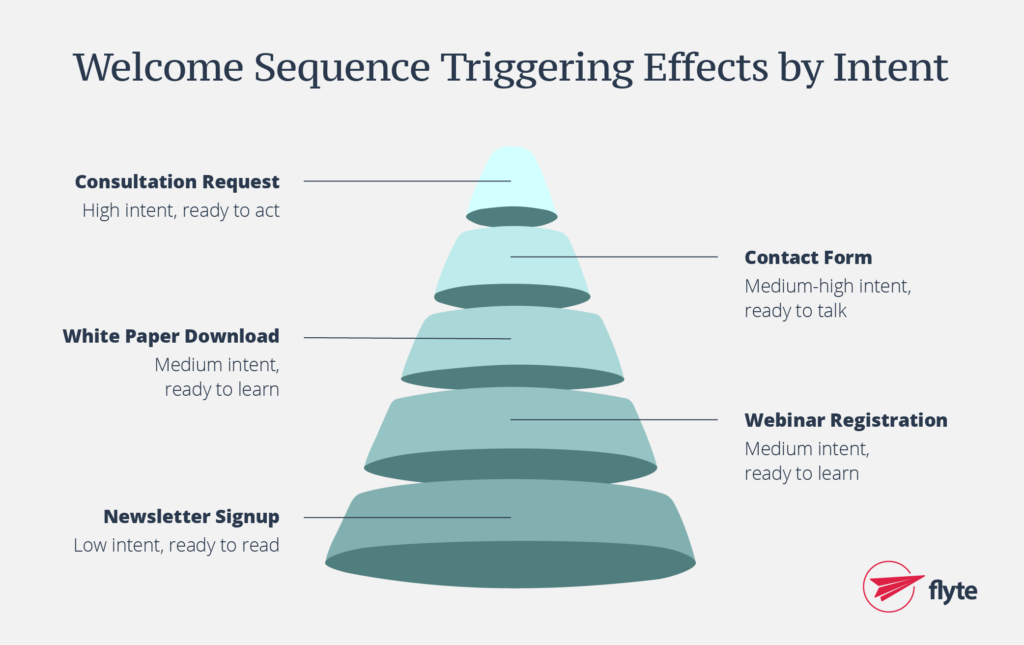
For service businesses, common email triggers include consultation requests, contact form fills, downloads, and more, each signalling a different level of interest and intent.
- Consultation or quote request: signals high intent (I’m ready to act!)
- Contact form: medium high (I’m ready to talk)
- Download (white paper): medium (I’m ready to learn)
- Webinar/event registration: medium (I’m also ready to learn)
- Newsletter signup: low (I’m ready to read)
Now, before you get overwhelmed thinking you have to create five (or more) welcome sequences, that’s not what I’m suggesting. I’m from the crawl-walk-run school, meaning you can and should start with just one sequence. As time goes on, you may find you want to promote a specific service or offering, and a second email sequence can be created then.
Almost any email service provider (ESP) these days, such as Mailchimp or Aweber, has the tools to build an automated drip campaign based on different actions or triggers.
What Goes Into Your First Welcome Email?
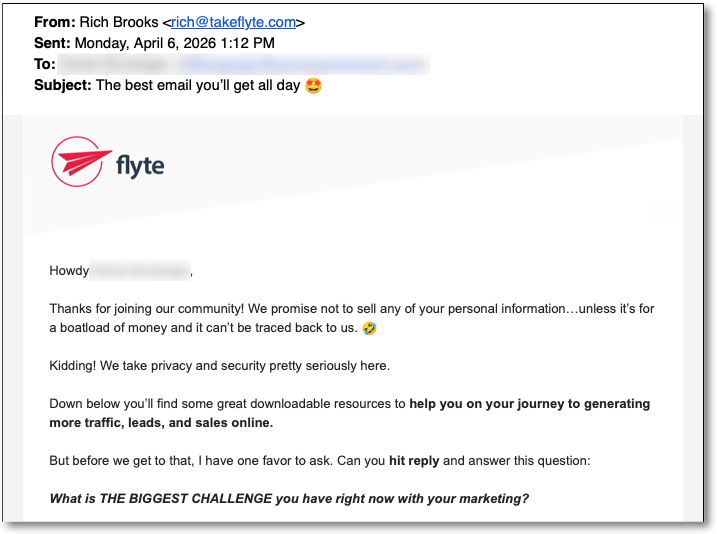
From my experience, the most important thing you can include in the first email in your sequence is…a question.
A question that your recipient is compelled to answer.
This accomplishes a few things:
- It changes the welcome email from a one-way megaphone to a one-to-one communication. Suddenly your recipient isn’t just on the receiving end of an email hundreds if not thousands of people have received, they are (hopefully) engaged in a real conversation with you.
- According to Tyler Cook of Hypermedia Marketing, that reply triggers a Gmail default setting that auto-adds you to the subscriber's contact list, giving future emails priority. (No, not all your subscribers are on Gmail, but it is one of the most popular email platforms.)
- It signals to you which new subscribers deserve your immediate attention.
This happened to me recently: a new subscriber responded to our welcome email question, “What’s the biggest challenge you have with your marketing right now?” His reply signaled to me that he was ready to take action. A follow-up email led to a proposal and ultimately a sale.
Had I not posed the question, and had he not answered, he’d still be struggling and I’d have one less client.
You may be compelled to add more to this email, listing all of your services, promoting different offers, introducing the team, and so on.
Resist the urge.
I interviewed Allea Grummert, an email marketing strategist and owner of Duett, on my podcast a while back and she said:

You want each email to have one big idea, and I would say no more than two calls to action in a welcome sequence.
I generally get overwhelmed with people when they've linked to 20 things in the welcome email. I'm just like, nope, I need two, tops, for me to actually consume it before we move the next email.
– Allea Grummert, Duett
Remember: even if they don’t respond to your question (and most won’t) you still have more opportunities to engage them in the coming days…assuming you don’t overwhelm them and they unsubscribe.
What Goes Into Your Follow-Up Emails In Your Welcome Sequence?
There’s no magic number of emails that should go into your welcome sequence…I’ve had as many as nine and as few as three, which is where we are now.
When I had nine I noticed that the open rate went down with each additional email, so by the time I was ready to make my big ask, most people never saw it. (Your ESP’s reports can show you where engagements fall off, giving you insight into where to improve your sequence.)
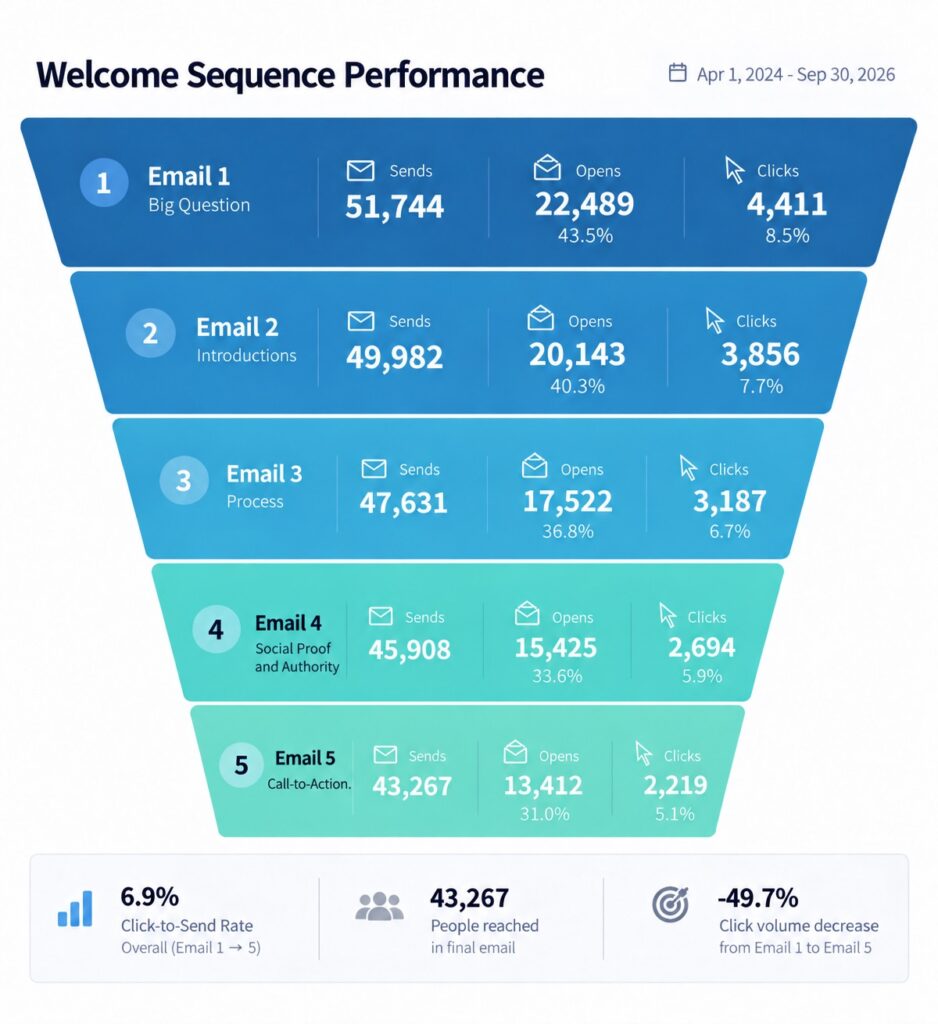
Exactly how many emails you send and what goes in them really depend on your business and your industry. Also, if you create multiple welcome email sequences based on different triggers, the content, frequency, and urgency may vary as well.
That being said, here are a few things that should be included in any service business's welcome drip campaign:
Introductions
Introduce yourself (and your team if relevant). This is not a time to play it safe with corporate-speak, but rather to lean in to who you are and be your authentic self. Not only will this help you win business from like-minded people, more importantly, it will help turn off the people who aren't a good fit for you.
Explain what you do, who you do it for, and why you got into this business in the first place. This is probably more important for smaller businesses, especially owner-led businesses, than it would be for a larger organization. Still, even for large corporations, this is a great place to explain your mission, vision, and values.
Process
People often have questions about how to get started and what’s going to happen next. Explaining those first few steps can reduce their fears and increase the chances that they'll want to do business with you. Maybe you have a named framework or a specific process that helps your clients succeed. This is a great opportunity to walk people through those steps so they can visualize their success with you.
Social Proof and Authority
Most people on a welcome sequence are just starting to get to know you. You may say wonderful things about yourself, but there's no way for them to know it's true. There are two proven behavioral levers that you can pull to quickly build trust with your new recipient.
Social Proof: We are social creatures by nature, and often look to others' actions and experiences to inform our own decisions.
For your email sequence this means including reviews, testimonials, and case studies. A case study from a customer who suffered from the same pain points as your new subscriber and achieved a great outcome by working with you can do wonders to help you build trust.
Authority: Authority is another trust-building principle that can increase the chances of conversion. In lieu of–or in addition to–social proof, you can leverage the power of other brands, such as logos, badges, or awards from recognizable clients, chambers of commerce, or accrediting organizations.

A Strong Finish
Whether your email sequence is two emails or twenty, you need to signal that the campaign is finished and provide a logical next step for your subscriber.
At this point, you've likely asked them what they're struggling with, introduced yourself, explained how they can work with you, and provided proof that you will be a trusted partner.
Offering a free consultation or a link to your booking app is a low-risk way to get your prospect to take the next step, depending on the cost of your services and your bandwidth.

Allea Grummert actually goes into her ESP reports to identify who are hot leads and sends them a personalized video. While that may not work for your business, it’s the kind of action that differentiates you from the competition and helps you land more business.
Next Steps for Your Welcome Email Series
The nice thing about an email welcome series is that it's not set in stone. Start with a 3- to 5-email sequence using the framework above, and then continue to improve on it.
If you go into your email service provider's reports and you see that one email is where a lot of people are dropping off–lower open rates or clickthrough rates–then you know it's a place to improve that particular email in the sequence.
Remember that everybody who's receiving this sequence has shown interest in your service or business. They signed up for the newsletter, or they registered for the webinar, or they downloaded your white paper. You need to treat them as interested parties.
Not sure what your welcome sequence should say, or how to build it in your email platform? Flyte can help you map the sequence, write the emails, and configure the automation. Book a free consultation and let’s turn more of your subscribers into customers and clients.
Bonus: You’ll get to see flyte’s welcome sequence in action!

Rich Brooks is president of flyte new media, a digital agency in Portland, Maine, offering branding, web design, and digital marketing. He is a nationally recognized speaker on marketing, AI, and entrepreneurship.
He founded The Agents of Change, an annual conference and weekly podcast that focuses on digital marketing.
Rich is the author of The Lead Machine: The Small Business Guide to Digital Marketing, a popular and well-received book that helps entrepreneurs and marketers reach more of their ideal customers online.