
Why A Great Name Matters
A great name does more than sound good. It supports your brand, builds recognition, and sets the tone for how people think and feel about your company.
Your name can instantly communicate credibility, professionalism, or personality. It can inspire people curious to learn more, engage with the brand, and become loyal customers.—or make them instantly forget you. In a world where attention spans are short and first impressions are digital, your name might be the difference between someone clicking in or scrolling past.
It also becomes part of your long-term brand equity. When done well, your name becomes an asset that gains value over time, earning trust and recognition at every interaction.

"The company name is the cornerstone of the company brand. It is intrinsically tied to the brand and its reputation."
~ Ryan Goan, Creative Director, flyte
Key Qualities Of A Great Name
- Memorable and sticky. A great name is easy to recall after a single exposure and leaves a mental imprint that helps your brand stand out in crowded markets.
- Relevant to the brand or offering. The name should connect logically or emotionally to what the company does, what it believes, or the value it delivers.
- Simple and easy to spell/pronounce. If people can’t say it, spell it, or search for it, they may not talk about it. While the flyte name has posed some SEO and spelling challenges over the years, we have been able to overcome them by leveraging the names memorability, simplicity, and uniqueness to help build our own unique brand.
- Unique and distinctive. A strong name clearly separates you from competitors and avoids blending into a sea of similar-sounding brands.
- Flexible enough to grow with the business. The best names allow room for expansion, new offerings, and evolution without forcing a future rebrand.
- Available (legally and digitally). No matter how strong a name sounds, it must be usable in the real world—free of major trademark conflicts and reasonably available online.
Naming Do’s And Don’ts
A few guidelines to keep your process focused:
Do:
- Keep it short, clear, and easy to say. Shorter names are easier to remember, easier to share, and more likely to stick in everyday conversation.
- Think about how it will sound in conversation. Your name should feel natural when spoken aloud, whether someone is recommending you or answering the phone.
- Make sure it fits your brand’s tone and reinforces your positioning. The name should immediately support how you want your brand to be perceived—e.g. serious, friendly, innovative, premium, etc.
- Check legal availability before falling in love. Early trademark and domain checks can save you from costly changes and disappointment later in the process.
- Tell a story or spark curiosity. The strongest names invite interest and give you something meaningful to build your brand narrative around.
Don’t:
- Get too clever for your own good—clarity beats complexity. If a name needs to be explained every time, it’s creating friction instead of recognition.
- Pick a name that boxes you in too tightly. Overly specific names can limit future growth, new services, or market expansion. Think eToys vs. Amazon.
- Choose the flavor of the month. Think of all the companies that wanted to signal they were forward thinking by including “dot com” in their names. Those that survived spent a lot of money and resources dropping that suffix. Next up: companies with AI in the name.
- Skip the legal or domain checks. Falling in love with a name before doing due diligence. Ignoring due diligence can lead to legal issues, forced rebrands, or confusion with existing companies.
- Choose based on personal preference alone. A great name should be chosen strategically, based on business goals and audience perception—not just what the founder likes best.
The Naming Process: A Step-By-Step Checklist
Naming isn’t magic—it’s methodical. The best names are the result of a clear, intentional process that balances creativity with strategy. This is the framework I use when guiding clients through naming, whether they’re launching something new or rethinking something existing.
Step 1: Clarify the Brand
Before you start naming, you need to be clear about what the name needs to do.
Who is the company trying to reach? What problem does it solve? What does it stand for beyond its product or service? And just as importantly—how should people feel when they encounter the brand?
Tone matters here. A name for a fintech startup should feel different than one for a wellness brand or a law firm. Are you aiming to sound bold, friendly, premium, disruptive, trustworthy, or understated?
Without clarity at this stage, naming becomes subjective and chaotic. With clarity, it becomes focused and intentional. Every good naming decision depends on the answers you define here.
Step 2: Set Goals for the Name
Not all names are meant to do the same thing.
Some names are designed to be immediately clear and descriptive. Others are meant to spark emotion (Weight Watchers), curiosity (Rocket Mortgage), or imagination (Apple). Some are intentionally literal (The Container Store). Others are abstract by design (Spotify).
Before you brainstorm, decide what you want the name to accomplish. Should it clearly explain what you do, or leave room for interpretation? Should it feel established and authoritative, or modern and energetic? Should it blend in within your category—or intentionally stand apart?
When your naming goals align with your business and brand goals, it becomes much easier to evaluate ideas objectively and avoid getting distracted by names that sound clever but don’t serve the bigger picture.
Step 3: Explore Name Types
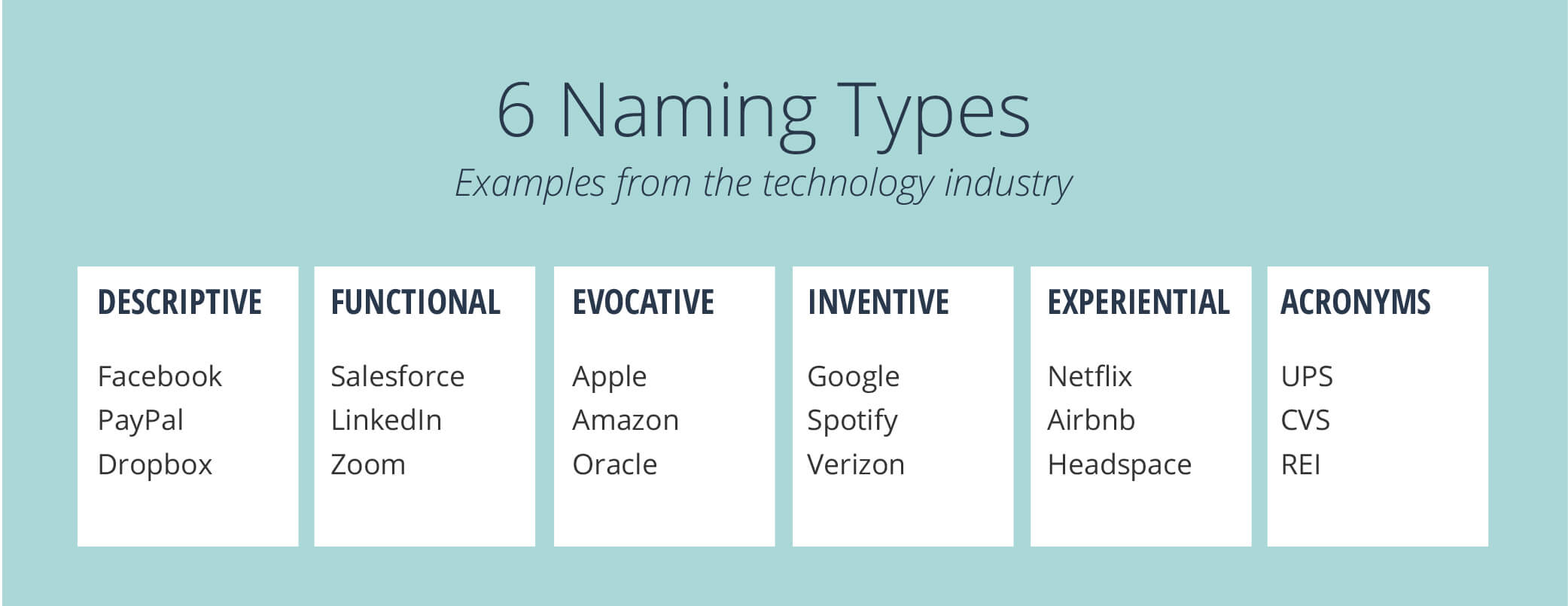
There’s no single “right” type of company name—only the right type for your brand.
Descriptive names offer clarity but can feel generic or limiting. Evocative or metaphorical names create emotional resonance but often require more brand-building. Invented names offer maximum ownership and flexibility, but they must still feel natural, intuitive, and easy to use.
Exploring multiple name types early in the process prevents you from narrowing too quickly and missing better options. It also helps you understand what styles of names feel most aligned with your strategy—and which ones don’t.
The goal isn’t to force a category. It’s to discover the naming territory where your brand feels most authentic.
Step 4: Brainstorm Broadly
This is where creativity earns its place—but structure still matters.
Effective brainstorming is expansive, fast, and judgment-free. Use word associations, mind maps, metaphors, industry language, cultural references, and even unexpected sources to generate ideas. Push past the obvious. Push past the “safe” options.
Most great names don’t show up in the first ten ideas. They show up after you’ve exhausted the predictable ones.
This is also where collaboration helps. Different perspectives often surface connections and ideas you wouldn’t reach on your own. The goal isn’t to find the name yet—it’s to build a deep pool of possibilities worth exploring.
Step 5: Shortlist & Vet
Once you have a long list, the work shifts from expansion to refinement.
Start narrowing. Say each name out loud. Use it in sentences. Imagine it on a website header, a business card, or an email signature. Pay attention to how it sounds, how it feels, and what it unintentionally suggests.
This is where weak names reveal themselves. Difficult pronunciation, confusing spellings, unintended meanings, or names that feel too similar to competitors should be flagged early.
A strong shortlist doesn’t just include names you like—it includes names that work.
Step 6: Legal & Digital Checks
Even if a name feels perfect, it won’t work if it’s already taken. This step often eliminates favorites—and that’s normal. It’s far better to lose a name here than to discover legal issues, forced compromises, or expensive rebrands later.
Practical constraints don’t weaken great naming—they sharpen it.
Legal Checklist:
- Trademark conflicts in your country. Search existing trademarks to ensure your name won’t infringe on another brand or expose you to legal challenges.
- Domain availability (ideally a clean .com). Your domain should be easy to remember, easy to type, and closely aligned with your company name whenever possible.
- Social media handles (or reasonable variations). Consistent or closely related handles across platforms help reinforce brand recognition and prevent confusion.
This step often kills some favorites—but it’s better to find out now than after a costly rebrand.
Step 7: Selection & Validation
When you’re down to a small group of finalists, it’s time to pressure-test them.
Share the names with trusted advisors, internal stakeholders, or even prospective customers. Ask what the name makes them think of. Ask how it feels. Ask whether it sounds like a company they’d trust or want to engage with. Pay attention not just to their opinions, but to patterns.
Selection Checklist:
- What does this name make you think of? This reveals whether the name communicates the intended message—or sends unintended signals.
- Is it easy to say and remember? If people hesitate, mispronounce it, or forget it quickly, the name may create unnecessary barriers.
- Does it feel like a fit for what we’re building? The right name should align with both your current vision and where you see the brand going long-term.
Then make the decision with confidence. A great name should be grounded in strategy, validated by feedback, and supported by instinct. When the process is solid, the final choice tends to feel less like a gamble—and more like a natural conclusion.
Great Company Name Examples
Here are a few of my favorite company names, and why I think they are so successful.
- Apple – An approachable, unexpected name in the tech industry. Memorable, simple, and human.
- Ben & Jerry’s – Feels local, friendly, and authentic.
- Google – Invented from “googol,” suggesting massive data; unique and memorable.
- Lyft – A playful twist on “lift”; modern, fresh, simple, and informal.
- PayPal – Suggests friendly, uncomplicated online payments.
- Robinhood – Suggests democratizing finance; personal and emotionally resonant.
- Whole Foods – Describes the core offering: natural, unprocessed groceries.
- Zoom – Simple, fast-sounding, unique, memorable, and perfect for a video platform.
Conclusion
Naming is one of the most important decisions you’ll make when building a brand. It’s not something to rush, outsource to chance, or treat as an afterthought. Your name becomes the foundation upon which everything else is built—your identity, your reputation, and your long-term equity.
The best company names aren’t just clever or creative. They’re clear, intentional, and aligned. They grow stronger over time as the brand delivers on its promise and earns trust.
By following a thoughtful process—and balancing creativity with strategy—you give yourself the best chance to create a name that doesn’t just sound good today, but continues to serve your business well into the future.
A great name isn’t discovered.
It’s built.
If you’re ready to build a great name for your company–or rename your company or product–but want some outside guidance, we’re here to help. Contact us today and let’s get naming!
Ryan is responsible for working with clients to help them design a successful web presence. Working in design studios from New York City to Portland, Ryan brings over 24 years of design experience to flyte. His diverse design background brings a fresh approach to each new project.