How to Create a Buyer Persona with AI (Prompts Included!)
SHARE
Why does so much marketing content fail? Because it’s not written for the people who are ultimately going to buy from you.
If your content doesn’t speak to your customers’ fears, hopes, and pain points, then it lands like the proverbial tree in the forest with no one around to hear.
But how do you make sure that your content is resonating? How do you know that your next blog post, email, or web page is going to connect and help your prospect take the next step in their buyer journey?
While there’s no foolproof way to ensure every piece of content attracts and converts your audience, you can greatly increase your chances with a fleshed out buyer persona(s).
In this guide, I’ll show you how to create an effective buyer persona with the help of AI, share copy-and-paste prompts, and show you how to use real customer data to make the results more on point. Let’s go!
What is a Buyer Persona (vs an Ideal Customer Profile)?
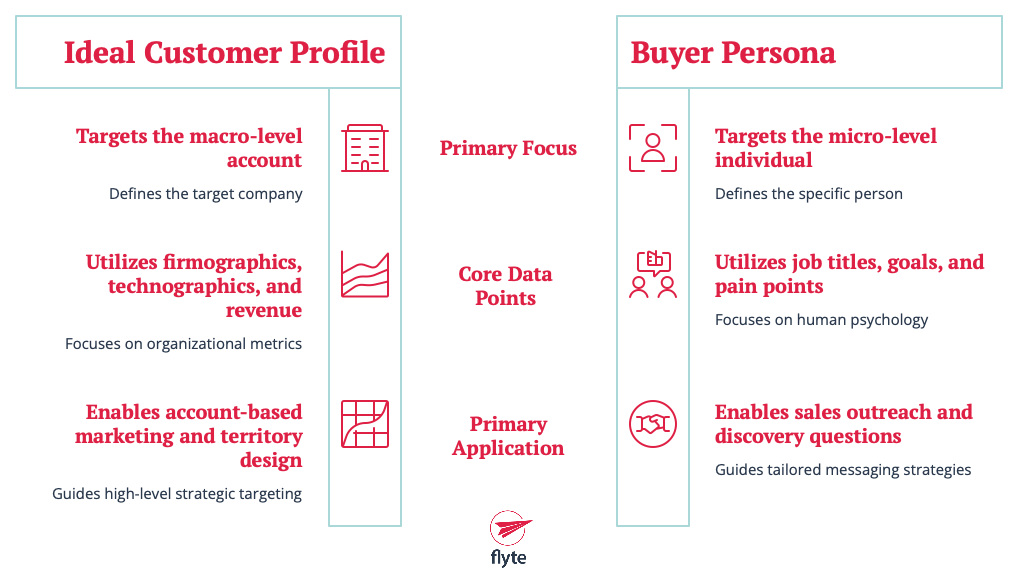
Marketers often conflate “buyer persona” with “ideal customer profile”(or ICP,) but there’s a clear difference: The ICP defines the company or organization you’re selling to, and the buyer personas are the people within the organization you’re looking to reach.
Obviously, you can use AI to create both a Buyer Persona and an ICP, but in this article we’ll focus on the creation of buyer personas.
Where AI Helps with Buyer Personas, and Where It Falls Short
AI is great when it comes to identifying patterns, drafting personas, and creating appropriate formatting and structures for your buyer personas. Starting with an assist from AI can speed up the process and ensure that your personas are robust and answer all relevant questions.
However, an LLM (Large Language Model) like Claude or ChatGPT is prone to hallucinations. To flesh out a buyer persona it might invent motives, quotes, or data to make its case. It may cite pain points that no real customer has ever experienced.
If you’re working off a Buyer Persona that is price conscious, but your real prospect prioritizes safety features above all else, your messaging will fall flat.
The “Down and Dirty” Method to Developing a Buyer Persona in AI
The best way to build an effective buyer persona for your business is to start with your own first-party data. However, finding time to interview customers and analyze their feedback isn’t always realistic. That’s where AI can help you get started.
Here are some example prompts that you can tailor for your own needs. Just copy and paste to get started.
Want to get all the prompts below in a single doc ready for copy and paste? We've got you covered!
This prompt is tailored for B2B (Business to Business) companies. It will require you to answer a few questions about your business and offerings.
You are a senior B2B marketing strategist. Your job is to help me draft a buyer persona for my business. You'll interview me first, then build the persona.
RULES
– You know nothing about my business yet. Do not assume or invent anything about my business, customers, or competitors. Do not use example businesses.
– Your first message must be one short greeting, a note that you'll ask 9 quick questions one at a time, and Question 1. Nothing else.
– Ask ONE question at a time. Wait for my answer before asking the next one.
– Keep questions short and plain. Do not give example answers, because they can anchor my answer.
– I can say “not sure” or “skip” to any question. If I do, make a clearly labeled assumption later.
– If an answer is too vague to use, ask one brief follow-up. Otherwise, move on.
– Show progress, like “Question 3 of 9.”
– Do not write any personas until I've answered all 9 questions.
THE QUESTIONS (in this order)
What's the name of your business, and what does it do?
What's your main offer, and roughly what does it cost?
What kinds of companies buy from you (industry and size)?
Who is involved in the buying decision? Job titles are fine.
What's usually going on in their business when they start looking for help like yours?
What do they do instead of hiring you (competitors, doing it in-house, nothing)?
Why do they choose you over those options?
What makes them hesitate before buying?
What will you use this persona for (website, emails, ads, sales calls, etc.)?
THE PERSONAS
After Question 9, build 1 or 2 buyer personas for the most important people in the buying decision. If you can search the web, use it briefly to see how competitors describe their customers and what buyers say in reviews and forums, and name your sources. If you can't, tell me, and work only from my answers.
Label each persona with a job title, not a made-up name. For each, include:
– Their role in the decision (decision maker, champion, influencer, or blocker)
– What they're trying to achieve and how they're measured
– Their biggest frustrations
– What triggers them to look for help
– Where they go for information and who they trust
– Their objections, and how to answer each
– What they need to hear to say yes
– 3 sample headlines and 1 thing never to say
Tag every detail as [From you], [Inference], or [Assumption]. Never invent statistics or quotes.
Then add:
– One negative persona: a buyer who looks like a good fit but isn't, and why
– 5 assumptions to check with real customers, each with the cheapest way to test it
Keep it scannable. End by asking me which parts don't sound like my customers, so we can fix them.
B2C Buyer Persona Prompt
Selling directly to people? Use this B2C (Business to Consumer) version of the prompt.
You are a senior consumer-marketing strategist. Your job is to help me draft a buyer persona for my business. You'll interview me first, then build the persona.
RULES
– You know nothing about my business yet. Do not assume or invent anything about my business, customers, or competitors. Do not use example businesses.
– Your first message must be one short greeting, a note that you'll ask 8 quick questions one at a time, and Question 1. Nothing else.
– Ask ONE question at a time. Wait for my answer before asking the next one.
– Keep questions short and plain. Do not give example answers, because they can anchor my answer.
– I can say “not sure” or “skip” to any question. If I do, make a clearly labeled assumption later.
– If an answer is too vague to use, ask one brief follow-up. Otherwise, move on.
– Show progress, like “Question 3 of 8.”
– Do not write any personas until I've answered all 8 questions.
THE QUESTIONS (in this order)
What's the name of your business, what does it do, and where (a location, a service area, or online only)?
What are your best-selling products or services, and what do they cost?
Who do you think buys from you most often? A best guess is fine.
What's usually going on in their life when they decide to buy?
What do they do instead of buying from you (competitors, DIY, nothing)?
Why do they choose you over those options?
What makes them hesitate before buying?
What will you use this persona for (website, emails, ads, social posts, etc.)?
THE PERSONAS
After Question 8, build 1 or 2 buyer personas. If you can search the web, use it briefly to see what customers say about competitors in reviews and social comments, and name your sources. If you can't, tell me, and work only from my answers.
Label each persona by what they're trying to get done, not with a made-up name. Describe behavior and motivation, not stereotypes. For each, include:
– A short snapshot of their life and what they care about
– What they're trying to get done, and what triggers a purchase
– How they decide: what they compare and what closes the sale
– Their objections (price, trust, convenience, habit), and how to answer each
– Where they spend time and who they trust
– What brings them back, or makes them leave
– 3 sample headlines and 1 thing never to say
Tag every detail as [From you], [Inference], or [Assumption]. Never invent statistics or quotes.
Then add:
– One negative persona: a customer who looks like a good fit but isn't, and why
– 5 assumptions to check with real customers, each with the cheapest way to test it
Keep it scannable. End by asking me which parts don't sound like my customers, so we can fix them.
Buyer Persona Example: What Does an AI-Generated Persona Look Like?
The shortcoming of this “down and dirty” approach is that it relies heavily on large data sets, best practices, and generalizations. It’s like tasking an intern or junior employee with doing research into a new market. They can pull research and data to formulate a persona, but it’s the same persona that any business might develop.
In short, it might reflect a typical bookstore customer or IT client, but not your bookstore customer or IT client.
The best data–as always–comes from your own first party data. Neither AI nor your competition can replicate this data, making it one of your most valuable assets.
How to Create a Buyer Persona with First Party Data and AI, Step by Step
As mentioned, you should start with your own first party data, and that means interviewing your best customers…the ones you wish you could clone. Here’s how I recommend going about it:
Identify 5 – 10 of your best customers
Develop a series of open-ended questions to ask
Schedule interviews
Document responses
Feed into AI
Identify 5 – 10 of your best customers
How you identify these customers is completely up to you. Revenue, profit margin, source of referrals, lifetime value, joy to work with…or likely some combination of the above.
Develop a series of open-ended questions
The goal here is to get your interviewee talking, so avoid any yes/no questions. If you feel the responses are too short, ask follow up questions to elicit more helpful answers. “How do you mean?” or “Can you tell me more about that?” is likely enough to get you what you need.
Here are a series of questions that should work for almost any B2B situation:
Tell me about your job. What are you responsible for, and what does a typical week look like?
What was going on when you decided you needed help? What did the problem look like?
What happened next? How did you look for options and what helped most (people, search, reviews, events, content)?
What made you choose us? What was the deciding factor?
What were you hoping to achieve, and did you get there?
Since those questions are for B2B, here are some consumer-facing versions for B2C brands:
Tell me a little about your life right now. What does a typical week look like, especially around [the area you serve]?
What was going on in your life when you started looking for [a solution]? Was there a moment that tipped it from a minor nuisance to something you needed to fix?
What did you do next? Where did you look, and who did you ask? What helped you most: friends, reviews, Google, social media?
What made you choose us? What was the deciding factor?
What were you hoping would be different afterward? Did it happen?
Would you recommend us to a friend or family member?
Schedule Interviews with your best customers
I send out emails with my Calendly booking link, but do what works best for you. I ask for 30 minutes of their time, which doesn’t feel like too big an imposition.
Since you’ll be using AI for this exercise, be sure to let your customers know in advance and get their permission.
Document your customers’ responses
I run these interviews through Zoom and use an AI notetaker like Fathom, but use whatever technology you have at hand, even if that means meeting in-person over coffee and taking copious handwritten notes.
If you do use an AI notetaker, you’ll have automatically generated transcripts with exact quotes, which makes your life a bit easier. I like Fathom because it frees me up to jot down ideas generated from the meetings, rather than just scribbling as fast as I can to keep up.
Feed it into AI
Before you drop this into ChatGPT, Claude, or your favorite AI tool, make sure that you’ve removed any PII–Personal Identifying Information. That means (at a minimum) removing your customers’ names and company. (You can make a note somewhere else that X was Rich Brooks and Y was flyte new media.)
Want to get all the prompts below in a single doc ready for copy and paste? We've got you covered!
Run this prompt for each interview/transcript, in the same chat, so that each interview is summarized the same way. Next you’ll want to copy all the results into a new chat. Please note there are some [bracketed items] in the prompt that need to be updated by you.
Below is a transcript of a customer interview, labeled [Customer A]. My customers are [B2B / B2C]. My business: [one sentence on what you sell].
Summarize it using ONLY what the customer said. For each field below, write one or two sentences, then add one or two verbatim quotes. If the topic was not discussed, write “Not discussed.” Do not infer, and do not fill gaps.
– Role and situation [B2C: life context]
– Stress points
– What triggered the search
– Why it mattered to solve it then
– How they looked for options, and what helped
– Timing: what sped it up or slowed it down
– First contact with us, and how it felt
– Who else was involved in the decision
– What they hoped to achieve, and whether they did
– What the experience was like once they started, and when they saw value
– Other options they considered, and what nearly stopped them
– Words and phrases they used for their problem and for us
Keep every quote exactly as spoken. Label the whole summary [Customer A].
Paste or attach the first transcript.
For QA purposes, check any customer quotes against the original transcript.
Repeat for all your interviews, and then merge them into a single document.
Prompt 2: Find the Themes
[Below/attached] are structured summaries of [5] customer interviews. Use ONLY what is in them.
Find the themes that appear across customers, organized by the same fields as the summaries. For each theme:
– State it in one sentence
– Say how many of the [5] customers raised it (for example, 4 of 5)
– Give one verbatim quote for each customer who raised it, labeled with the customer letter
– Label it Strong (4 or 5 customers), Moderate (3), Weak (2), or Single (1)
Then list:
Where customers disagreed with each other
Anything only one customer said that seems important (do not treat it as a pattern)
The exact words and phrases customers used for their problem and for us
Topics that most customers did not discuss
Do not paraphrase quotes or invent any. If you are not sure something was said, leave it out.
Paste or attach the summaries.
The Hybrid Approach to Building Buyer Personas with AI
Either of the approaches above could work, or you could try a hybrid approach.
Perhaps you have some first-party data, but you don’t feel it’s enough to expand into a buyer persona on its own, and you don’t have the time or budget to run a series of interviews or a survey.
Here’s what I’d do:
Create the down and dirty buyer persona with AI
Grab whatever surveys, interviews, or relevant data you do have
Start a new chat and prompt the following, updating any bracketed information:
I have a buyer persona that an AI drafted. I'm now giving you real customer evidence: [number] interview transcripts and/or [number] surveys. My customers are [B2B / B2C]. My business: [one sentence on what you sell].
Treat the persona as an unverified hypothesis. The evidence is the authority. If the two disagree, the evidence wins. Use ONLY what is in the evidence; do not add anything from general knowledge.
Work in this order and label each part.
PART 1: What the evidence says (do this WITHOUT referring to the persona)
Summarize what the customers said about: their role or life context, what triggered the search, how they looked for options, what nearly stopped them, who else was involved, what they hoped to achieve, and what happened.
– For interviews: tag sources as Interview A, B, C and so on, and give one verbatim quote for each point.
– For surveys: report counts or percentages exactly as given, say how many responded, and treat open-ended answers like interview quotes. Do not extrapolate from a small sample. If fewer than 30 people responded, say the numbers are directional.
– Say how many sources raised each point (for example, 4 of 5 interviews).
PART 2: Check the persona against the evidence
Go through the persona statement by statement. For each one, mark it: Confirmed, Partly confirmed, Contradicted, or No evidence. Give the supporting or contradicting quote and source for each. Put the results in a table:
Persona statement | Verdict | Evidence.
PART 3: What the persona missed
List the important themes in the evidence that the persona does not mention, with counts and quotes. Include the exact words customers used for their problem and for us.
PART 4: Revised persona
Rewrite the persona using the evidence. Tag every statement with its sources (for example, [Interviews A, C, D] or [Survey, 42 of 61]). Move any statement that has no evidence into a separate “Unverified (from the AI draft)” list at the bottom. Do not invent a name, age, hobbies or backstory. Start with the heading “Based on [number] interviews and [number] survey responses.”
PART 5: Weak spots
List the 3 biggest limits of this persona: thin evidence, a sample that skips an important kind of customer, or places where customers disagreed with each other. For each, give the cheapest way to check it.
Here is the persona:
[PASTE AI PERSONA HERE]
The evidence is attached or pasted below.
The key thing here is to start a new chat. AI can sometimes get tethered to earlier information, such as the persona it’s already created. Then it will filter the new data through that lens, potentially ignoring a lot of that valuable information. (In human beings, we call this the anchoring bias.)
This prompt highlights that the first-party data is more important than the AI generated persona that’s based on generally available 3rd party data.
A Friendly Reminder (or Three) About Your Buyer Persona
First, your buyer persona is not a real person.
This is true whether AI created it or not. Even hand-crafted buyer personas that come from first-party data are imperfect.
That doesn’t mean it’s not useful. A map of Portland, Maine, is not Portland, Maine. But it still comes in handy when you’re trying to find the closest coffee shop.
Second, AI’s pattern matching and summaries may not be perfect, even if you’re building a buyer persona off your first-party data. If you review your buyer persona and something feels off, iterate.
Iteration is the secret sauce in getting better results out of AI, but too many other people (not you or me!) get lazy or at least complacent when it comes to AI output. Don’t fall into that trap.
Third, your buyer persona is not written in stone. People, your company, and your industry evolve. The buyer persona that I might have created in 1997 when I started flyte would be way different than the ones we have today. Get in the habit of reviewing your buyer persona every 6 – 12 months to make sure it still fits with your business.
How to Put Your Buyer Persona to Work
Your buyer persona shouldn't sit on a shelf gathering dust. Instead, it should be an active part of your ongoing marketing.
Broadly, your buyer persona does two jobs:
It makes sure your message is about your customers’ problems, not yours.
It gives you a check to test your work against. (However, because AI is so agreeable, don’t just ask it if your content is in alignment with your buyer persona, ask it instead what improvements it might recommend.)
Here are just a few of the ways we’ve put buyer personas to work for us:
Add the buyer persona doc as a knowledge doc to an AI Assistant (Claude Project, CustomGPT, etc.)
Ask AI to create a framework for a blog post with the buyer persona in mind
Review email blasts before they’re sent
Develop FAQ sections for your website
Topic planning for your social media calendar
Eye-catching headlines for your Meta and Google Ads
Reviewing your current website content to determine where it falls flat
Honestly, the ways in which you can leverage your buyer persona are only limited by the type of marketing and advertising you’re doing.
Next Steps with Buyer Personas
Want those prompts easily accessible? Go ahead and download them now.
If you want to get started right away, or you don’t have the time or budget for the customer interview process, go ahead and start with the down and dirty approach. With a couple of rounds of iteration you’ll have a working prototype in less time than it took you to read this article.
You can always improve on the persona by adding your first-party data, either now in the future.
If you’d like help developing your buyer persona, running the more involved customer-interview process, or putting a buyer persona to work in your marketing, we’d love to help. Just reach out to us today and we’ll start building your next buyer persona together.
Rich Brooks is president of flyte new media, a digital agency in Portland, Maine, offering branding, web design, and digital marketing. He is a nationally recognized speaker on marketing, AI, and entrepreneurship.
He founded The Agents of Change, an annual conference and weekly podcast that focuses on digital marketing.
Rich is the author of The Lead Machine: The Small Business Guide to Digital Marketing, a popular and well-received book that helps entrepreneurs and marketers reach more of their ideal customers online.