
Are you worried AI tools like Google AI Overviews, ChatGPT, or Perplexity are recommending your competitors instead of your business? Generative engine optimization, or GEO, helps you improve how your business appears in AI-generated answers—and gives you a better shot at earning qualified traffic from AI search.
In this article you’ll discover how AI is changing the buyer journey and what you need to do for tomorrow’s highest-converting referral engine.
While most of today’s articles on GEO are written for large corporations or giant SaaS companies, this guide is for real-world business owners or marketers; people without unlimited budgets or timelines, but who recognize that change is happening again and want to stay ahead.
So, What is Generative Engine Optimization?
Generative Engine Optimization, or GEO, is the process of making your business easier for AI platforms to understand, trust, cite, and recommend. It includes improving your website content, strengthening your online reputation, and earning mentions from credible sources.
It has other names, including AIO (Artificial Intelligence Optimization), AEO (Answer Engine Optimization), and LLMO (Large Language Model Optimization). LOL.
And while they may have started with slightly different angles, they’ve basically come to mean the same thing. Going forward, we’ll refer to all of these activities under the umbrella of GEO.
Why Does GEO Matter to My Business?
The way people search for businesses and products like yours is changing. According to a recent Pew Research Center report, 42% of US Adults say they use AI chatbots to search for information. That was the number one use case, well ahead of news, medical advice, or emotional support.
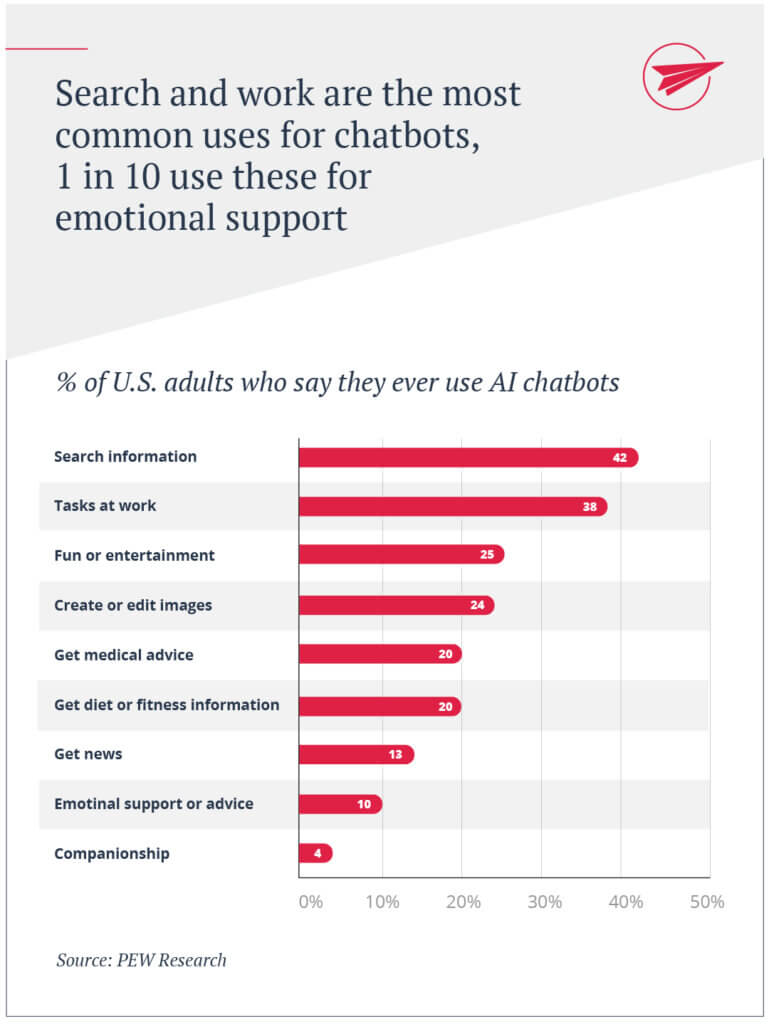
While the amount of searches on Google dwarfs current AI search, the latter is growing exponentially, and industry analysts such as SEMrush predict that AI-powered search will overtake traditional search by 2028.
Is your website ready? Is your business ready?
SEO vs. GEO: What’s the Difference?
While some experts have dismissed GEO as “three Google searches in a trenchcoat” (which made me laugh), there are important differences.
SEO helps your website rank in traditional search results. GEO helps your business get mentioned, cited, or recommended in AI-generated answers. While they overlap, GEO puts more emphasis on clear entities, credible claims, structured answers, and reputation signals across the web.
|
|
Traditional SEO |
GEO |
|
The Goal |
Get the searcher to click your link and visit your website. |
Get cited or mentioned in an AI-generated answer. |
|
How People Search |
Short, choppy keywords (e.g., “best dog walker NYC”). |
Full, conversational questions (e.g., “I need someone to walk Fido when I’m on a Zoom call. Who should I hire?”). |
|
What the Algorithms Value |
Links from other sites, fast page speeds, and keyword placement in titles and headings. |
Concrete statistics, clear definitions, quotes from named experts, highly structured data, and volume of brand mentions across the web. |
|
Key Reputation Sources |
Your own website and standard industry directories. |
Your website, industry directories, and places AI goes to “learn”: Wikipedia, Reddit, industry review sites (like G2 or Yelp), and digital PR features. |
|
The Technical Setup |
Optimizing your site for human readers and Google's standard web crawler. |
Creating clear summaries, using schema markup, breadcrumbs, and using an llms.txt file to explicitly tell AI scrapers exactly what your business does. |
|
The Impact on Your Traffic |
High Volume, Lower Intent: Brings a lot of visitors to your site who are still just browsing or looking around. |
Lower Volume, High Intent: The AI answers basic questions on its own, so you get fewer clicks. However, the clicks you do get are highly qualified leads who are already close to buying. It also increases your brand recognition and creates another touchpoint for your business. |
Please note that GEO is still a relatively new discipline: there is limited data on what works long-term, the platforms are being regularly updated and changed, and AI platforms are much more of a “black box” compared to search engines. In other words, your mileage may vary.
What AI Platforms Should You Care About?
When it comes to SEO and traditional search, there’s really only one target: Google. The same cannot be said about GEO. It’s a fragmented landscape.
Some people search with traditional LLMs (Large Language Models) like ChatGPT or Claude that use both their training data and web searches to answer questions. Others use AI-powered search engines like Perplexity. And likely we all use AI features that are now part of traditional search, like Google’s AI Overviews that are appearing on over half of all searches.
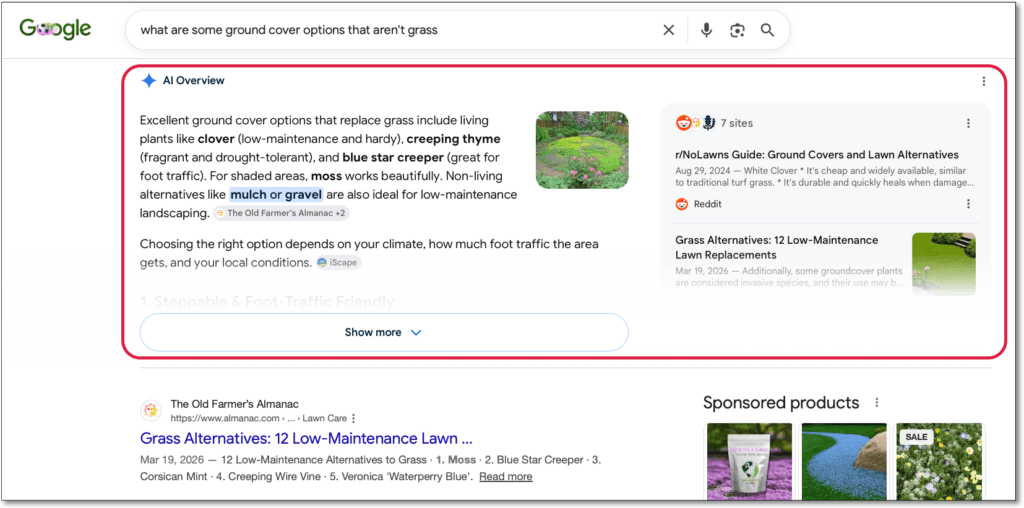
I queried some of my favorite AI platforms for what the top platforms we should focus on, and surprisingly, they were in agreement:
- Google Ecosystem (AI Overviews & Gemini) – Google is still king when it comes to search, commanding 90% of global searches. AI Overviews (like the one above) appear over half the time, although my search history would say closer to 80%.)
- ChatGPT – It reaches over 900 million weekly active users and drives the majority of measurable B2B AI referral traffic, according to Reporter Outreach.
- Perplexity AI – This one surprised me, but a lot of B2B professionals use it for search and it makes clickable links to your website more prominent.
- Microsoft Copilot – Critical for B2B.
- Claude – While it gets less mainstream search usage than ChatGPT or Google, it’s popular with many professionals and worth monitoring, especially in B2B contexts.
How to Rank in ChatGPT
Technically, ChatGPT doesn’t “rank” websites the way that Google does. Nor does Claude, Microsoft Copilot, or even Gemini. But you can improve your chances of being mentioned and recommended by making your business easier to understand, and back up those claims with data, reviews, media mentions, and other trusted sources.
But first, let’s see if AI even knows who you are.
Do You Even Show Up in AI? Here’s How to Check
There are two questions I immediately want to ask AI when it comes to a brand:
- What do you know about [my company]?
- What are the top five companies in my vertical?

Pro Tip: Start a fresh chat for both of these queries to limit the impact of previous conversations on the results of this one. You can even go further by having an incognito or temporary chat, available on some AI platforms.
What Does AI Know About Your Business?
When I first started asking the LLMs what they knew about flyte, they described us as a web design and digital marketing company in Portland, Maine. Which is true. But recently we’ve been doing a lot more work in branding: logos, brand guides, and brand strategies. We’ve even been building out some custom BrandGPT for our clients.
Although flyte new media is the longest running digital-first agency in Maine, the AI platforms didn’t know we also offered branding, because neither we nor any other sources were talking about it. Our soon-to-be launched website has a lot more content around branding, but it’s still not public.
Who Does AI Recommend When People Want Your Services?
Although AI doesn’t “rank” websites the way that Google does, I find it’s still helpful to get a sense of who they might recommend when someone asks. I often customize the question based on the company and its position in the market.

- Who are the top five forensic accounting firms in Greater Boston?
- What are the best low-cost time tracking software tools for freelancers?
- Who are the top five digital agencies in Maine?
Important Note: LLMs are probability engines, not consistent sources of information in how they answer questions. In other words, feed the exact prompt into the exact LLM and you’re unlikely to get the same answer.
Rand Fishkin of SparkToro shared some research into the probabilistic nature of LLMs:
To get mathematical about it, there’s a <1 in 100 chance that ChatGPT or Google’s AI, if asked 100X, will give you the same list of brands in any two responses. Claude is just slightly more likely to give you the same list twice in a hundred runs, but even less likely to do so in the same order.
–Rand Fishkin, SparkToro
In other words, if I ask those questions above, I could ask ChatGPT 100 times before it would repeat the first response. (Although not mathematically the same thing, you get the idea.)
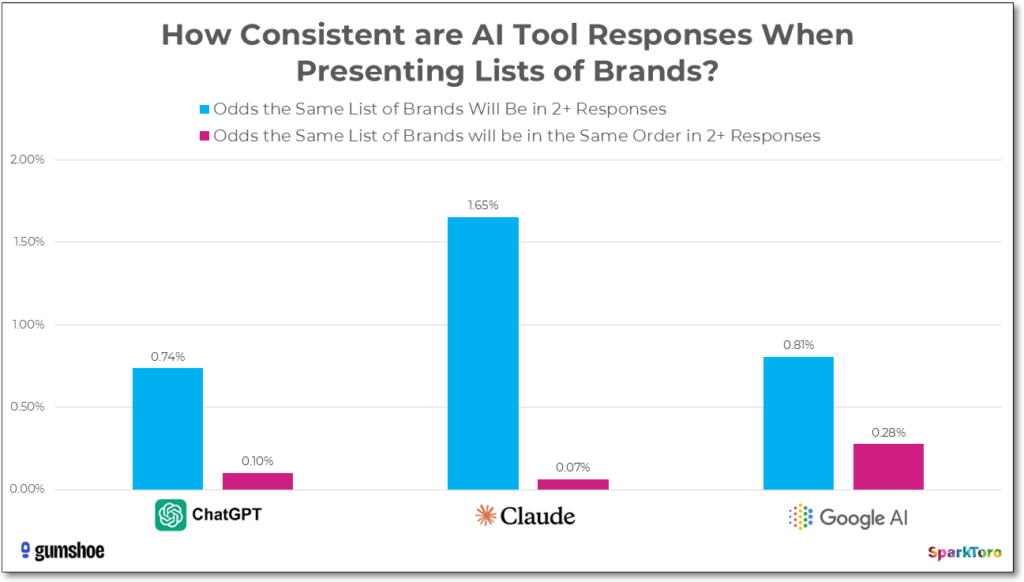
After that research, the takeaway from a lot of marketers was this isn’t something worth tracking, since the probabilistic nature of LLMs makes it useless.
I disagree.
The goal is not to get the same answer twice, but to come up as often as possible when your next customer asks AI who they should choose.
Generative Engine Optimization Strategies for Your Website
As noted above, but worth repeating, this is a new discipline: it lacks the years of data that comes with SEO, the AI platforms are being updated regularly, and AI doesn’t give us the same data and reports we get from search engines.
That being said, here are a few things you can do on your own website to increase your chances of getting recommended and driving more traffic. Many of these came from a research paper published by Princeton University, which coined the phrase “GEO”.
Back Claims with Numbers
Don’t say “we’re the best”, say “we have the highest customer satisfaction rating in our industry based on a decade of reports from J.D. Power and Associates.”
Rather than saying, “we’ve built a lot of houses,” say, “since we opened our doors in 2017 we’ve built 153 houses in western PA.”
Cite credible sources and link to them.
This signals that you’re a synthesizer of authority, not just spouting an opinion.
In his seminal book, Influence: The Psychology of Persuasion, Dr. Robert Cialdini talks about the six “weapons of influence” and one of them is authority.
If you’re going to be taken seriously, you should include the resources you drew from. (Like Rand Fishkin. And Dr. Robert Cialdini.)
Add Real Quotes
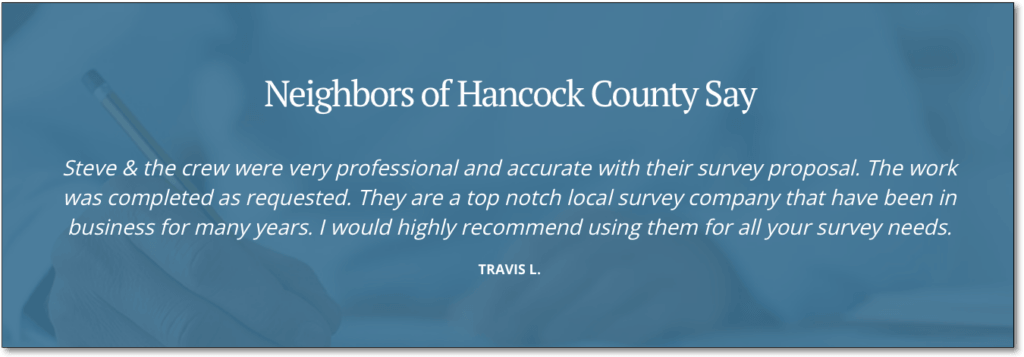
Customer quotes, expert quotes, your own hot take. Unrepeatable, human experiences are what these systems lift.
Don’t Bury the Lede
Answer the question in the first sentence, then support it. In journalism this is called the “inverse pyramid.”
Phrase Headers as Questions Your Customers Would Ask
“How much does a land survey cost in Bar Harbor, Maine?” beats “Our Pricing.”
Name Your Entity Early
AI thinks in entities and their relationships. “Rich Brooks” (me) is an entity. “flyte new media” is an entity. So is “digital agency”, “GEO”, and “Portland, Maine”. All entities.
Entities could be a person, place, thing, or idea. (See, Schoolhouse Rock is still relevant.)
AI also recognizes these entities sit near each other conceptually, so it can tie them together.
Your website should clearly state who you are, what you do, who you serve, and where you do it, early on the page. Some say in the first 100 words. Personally, I think that can ruin the flow of a page, so I might argue to use it judiciously.
But this is how the platform understands your brand as a recognizable thing it can recommend.
Remove Keyword Stuffing
I’m sure you aren’t keyword stuffing: the act of repeating a keyword you want to rank well for at the search engines. After all, that hasn’t worked since about 1997. Turns out AI hates it, too, and it reduces trust in everything else you’re saying.
Of course there’s more than just this, and there are technical things your developer can do like adding schema, removing any firewalls that keep AI bots out, and making sure your content renders in plain HTML, not only after JavaScript executes.
We recently ran into this with a client who hired us to improve their GEO: their navigation was JavaScript dependent and some models read the page as blank.
The Offsite Signals AI Platforms Trust
On your website, you can tell AI who you are. Offsite, the rest of the web decides whether to believe you.
However, you do have some control over this through earned and social media.
Here are some actions you can take.
Build Out Your Profiles
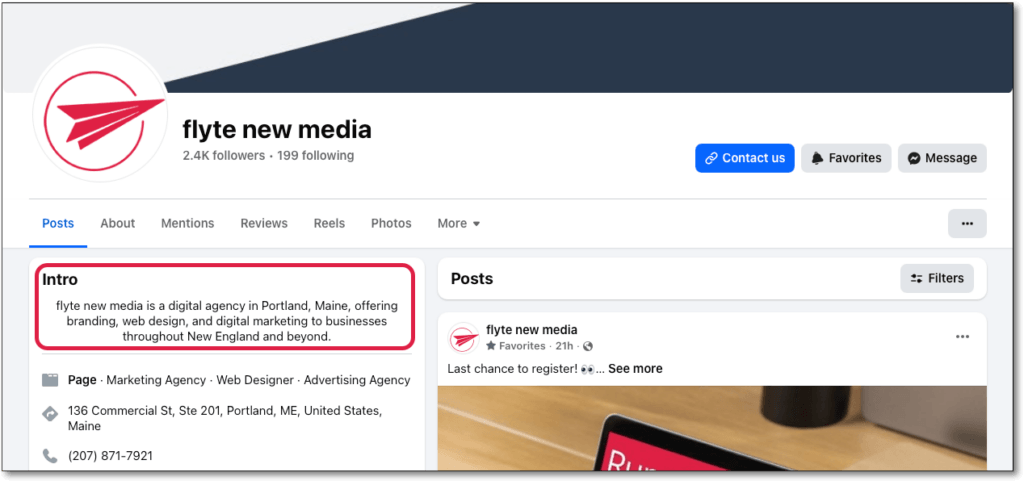
Make sure your information on Facebook, LinkedIn, and any other relevant social media profile or directory is accurate and up-to-date. Don’t forget your Google Business Profile, Chamber of Commerce listing, and so on.
Get on “Best of” Lists
When someone asks Claude “What are the best hotels in Bar Harbor” it doesn’t start from scratch, it synthesizes existing lists. So getting included in “Top 10 Bar Harbor Resorts” and “Best Dog Friendly Hotels” is important.
Earn Reviews Where They Matter
Whether it’s Google reviews, Angie’s List, Yelp, or an industry specific platform, reviews help inform AI platforms and reinforce what you’ve said about yourself.
Become the Source Others Cite
Publish original data, surveys, or proprietary stats. When other sites cite your numbers, those citations feed the engines, and you become the entity associated with that data point.
(See Rand Fishkin and SparkToro above.)
This is a lot of work, but it’s well worth it.
Get Earned Media and Digital PR
Submit press releases to sites like PRWeb.com. Hire a publicist. Get quoted in local and industry media.
Or become the 207 Tech Guru.
How to Measure GEO Results
On my Agents of Change podcast, which is all about digital marketing, I often ask my guests, “how do we know if this is working?”
After all, most of the actionable tips my digital marketing experts provide take time to implement and time to take effect. And most listeners are owners and marketers at businesses that don’t have unlimited budgets or resources. They want to know that something will work.
While the measurement tools for GEO aren’t what they are with SEO, there are still a few Key Performance Indicators you should pay attention to.
Tracking AI Referrals in Google Analytics
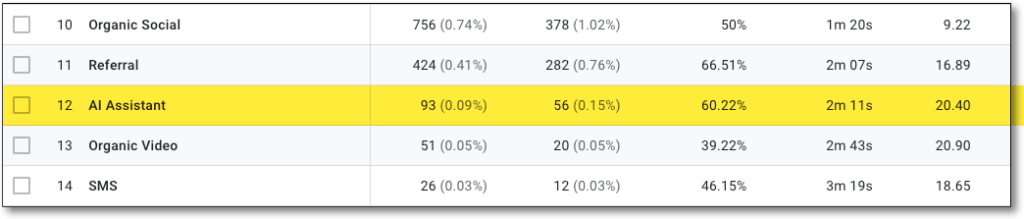
GA4 (Google Analytics) now includes an AI Assistant channel for recognized chatbot referrers like ChatGPT, Gemini, and Claude. While traffic isn’t the only indicator that your GEO is working, it can tie directly to your bottom line.
Tracking Responses Over Time
Start a spreadsheet that tracks what AI thinks of your company today, as well as its answers to the top 5 companies in your vertical. If you’ve got the bandwidth, ask some additional questions your ICP (ideal client persona) might ask, and include 3 – 5 of today’s top platforms.
Next month run those queries again, and see if you’re improving or losing ground. Again, the answers won’t be perfect because of the probabilistic nature of LLMs, but you're looking for trends, not absolutes.
Your Intake Form
I got this from AI expert Chris Penn, who recommends including a field–not a pulldown–on your contact form that reads: “How did you hear of us?”

When somebody on a contact form says, "I submitted this prompt into Claude and you guys came up as a great option," that is a number I would bet my job on. That tells me my GEO is working. I don't care what other systems you have, what other measurements you have. If nobody ever says, "I asked AI, and AI said to talk to you," your GEO is not working. So this is the measurement. This is how you do this.
– Chris Penn, Trust Insights
Once you have a critical mass of responses, you can drop them into your favorite AI platform and ask it to determine how many people cited AI as how they found you.
Why GEO Isn’t Replacing SEO
As stated above, the vast majority of your customers and prospects are still using traditional search to find you. Although powerful, search isn't even the only channel that leads to discovery. Social media, referrals, word of mouth, and advertising are just a few of the ways that your next best client may discover you.
Also, if you have been investing in your SEO over the years, a lot of that work will benefit your GEO. While AI platforms might turn to their own pre-training data first to answer a query, if they don't feel confident in their answer, they'll turn to the web. Which is maybe where we get the idea of SEO is just three Google searches in a trench coat.
That being said, the way we search is changing.
The first article I wrote about SEO was way back in 1997, and the companies that were quick to adopt SEO then had a competitive advantage for years over those who took a wait-and-see approach.
While past performance does not guarantee future results, working to make sure that AI understands your business and can recommend you feels like a solid bet to me.
If you have questions or want to get a better handle on how AI sees you and how you can improve your results, be sure to reach out to us today.

Rich Brooks is president of flyte new media, a digital agency in Portland, Maine, offering branding, web design, and digital marketing. He is a nationally recognized speaker on marketing, AI, and entrepreneurship.
He founded The Agents of Change, an annual conference and weekly podcast that focuses on digital marketing.
Rich is the author of The Lead Machine: The Small Business Guide to Digital Marketing, a popular and well-received book that helps entrepreneurs and marketers reach more of their ideal customers online.